TradingView to cTrader Trade Copier
The TradingView to cTrader Trade Copier is a cloud-based connector that executes TradingView alerts in cTrader across manual trading, strategy automation, and indicator automation workflows, with Low-Code and No-Code setup methods. It supports TP/SL from the alert or your own, flexible position sizing, reversal and pyramiding control, scale-ins and partial exits for No-Code strategies, prop trading limits, and a centralized admin panel.
Already a subscriber or have purchased a product?
How the TradingView to cTrader Trade Copier Works
The TradingView to cTrader Trade Copier is a cloud-based software utility for sending user-configured TradingView alerts to cTrader for automated trade execution — across manual trading, strategy automation, and indicator automation workflows, with no symbol mapping required.
Connect your Receivers on several platforms and symbols to the same channel, and one alert is executed on all of them. Receivers for every platform are included in the same subscription; each cTrader account requires its own license, which covers one demo and one live account.
Choose Your Trading Workflow
Use the copier for manual trading, strategy automation, or indicator-based automation. Compare the five workflows, then open the one that matches how you send trades from TradingView.
| Workflow | Alerts you create | Pine Script editing | Protected scripts | Best for |
|---|---|---|---|---|
| Manual Trading | 4 alerts — Entry Buy, Entry Sell, Exit Buy, Exit Sell — started by hand | Not needed | — | Discretionary traders |
| StrategyWith Script Access (Low-Code) | 1 strategy alert; alert messages added inside the strategy code | Required | Source code needed | Strategies you or your developer can edit |
| StrategyNo-Code Configuration | 1 strategy alert with a ready-to-use webhook message; the signal type is detected automatically | Not needed | Supported | Any TradingView strategy |
| IndicatorWith Script Access (Low-Code) | One alert condition per signal action | Required | Source code needed | Indicators with clear entry and exit conditions |
| IndicatorNo-Code Configuration | Up to 4 alerts with ready-to-use webhook messages | Not needed | When alerts are available | Existing and protected indicators |
Manual Trade Triggering from TradingView
Use TradingView alerts as manual trade triggers for Entry Buy, Entry Sell, Exit Buy and Exit Sell. When you identify a setup on the chart, activate the corresponding alert from the TradingView interface. The webhook signal is sent to the cloud server, and the trade is executed by the cTrader Receiver cBot.
This workflow is designed for discretionary traders who prefer making trading decisions manually, while still using TradingView alerts to execute trades through cTrader.
Automatic Strategy Alerts · With Script Access (Low-Code)
Use this workflow when you have access to the Pine Script strategy code and want to configure alert messages directly inside the strategy. The strategy generates automated trade signals, and TradingView forwards them to the copier through the webhook connection.
- Open the Pine Script strategy source code.
- Insert the provided alert message logic into the strategy.
- Create a TradingView strategy alert and configure the webhook URL.
- The strategy sends automated trade signals to the cTrader Receiver cBot.
Automatic Strategy Alerts · No-Code Configuration
Use this workflow when you do not have access to the strategy source code or prefer not to edit Pine Script. Copy and paste the ready-to-use webhook message provided in the client area into the TradingView alert settings.
No Pine Script editing or custom message formatting is required, and you do not need separate alert messages for each trade action — the system determines the signal type when the strategy order is triggered.
Automatic Indicator Alerts · With Script Access (Low-Code)
Use this workflow when you have access to the Pine Script indicator code and can configure alert conditions for specific signal events. It is useful when the indicator contains clearly defined bullish, bearish, or exit conditions and you want to control how each signal is forwarded to the cTrader Receiver cBot.
Each signal condition — Entry Buy, Entry Sell, Exit Buy, Exit Sell — can be linked to the corresponding Receiver-side trade action.
Automatic Indicator Alerts · No-Code Configuration
Use this workflow when the indicator source code is not available or when you prefer not to edit Pine Script. Configure the TradingView alert using the available indicator alert conditions and insert the ready-to-use webhook message provided in the client area into the alert settings.
This workflow connects existing TradingView indicators to the cTrader Receiver cBot without modifying the indicator source code.
TradingView to cTrader Trade Copier — Key Features
How the cTrader Receiver cBot executes TradingView alerts, how you scale the setup across your own cTrader accounts, and how you monitor every signal.
Execution
cTrader Receiver cBotMarket Orders with Optional TP & SL
TradingView entry alerts are executed as market orders in cTrader. Take Profit and Stop Loss can be taken from the incoming signal or replaced with Receiver-side values configured in ticks, with TP and SL enabled or disabled independently.
Flexible Position Sizing & Risk Models
Use the incoming signal volume with an optional multiplier, or calculate position size inside the Receiver:
Reversal & Pyramiding Behavior
Control what the Receiver does when a new entry alert arrives while a position is already open.
- Close all on reversal (default): opposite positions are closed before the new trade opens.
- Open a hedge: the existing position stays open and a position in the opposite direction is added.
- Pyramiding off (default): new same-direction entries are blocked while a Receiver-managed position in that direction is open.
- Pyramiding on: the Receiver adds to the existing position.
Scale-Ins & Partial Exits
In No-Code strategy workflows, the Receiver follows the position state of the TradingView strategy: it processes first entries, scale-ins, reversals and full closes, and calculates proportional partial exits from the previous and current strategy position size.
Execution Time Control
Define when trades are allowed to be executed based on the cTrader server time. Restrict execution to a selected session — including sessions that cross midnight — or allow execution at any time.
Scale
Channels, accounts and ReceiversOne Channel, Several Platforms
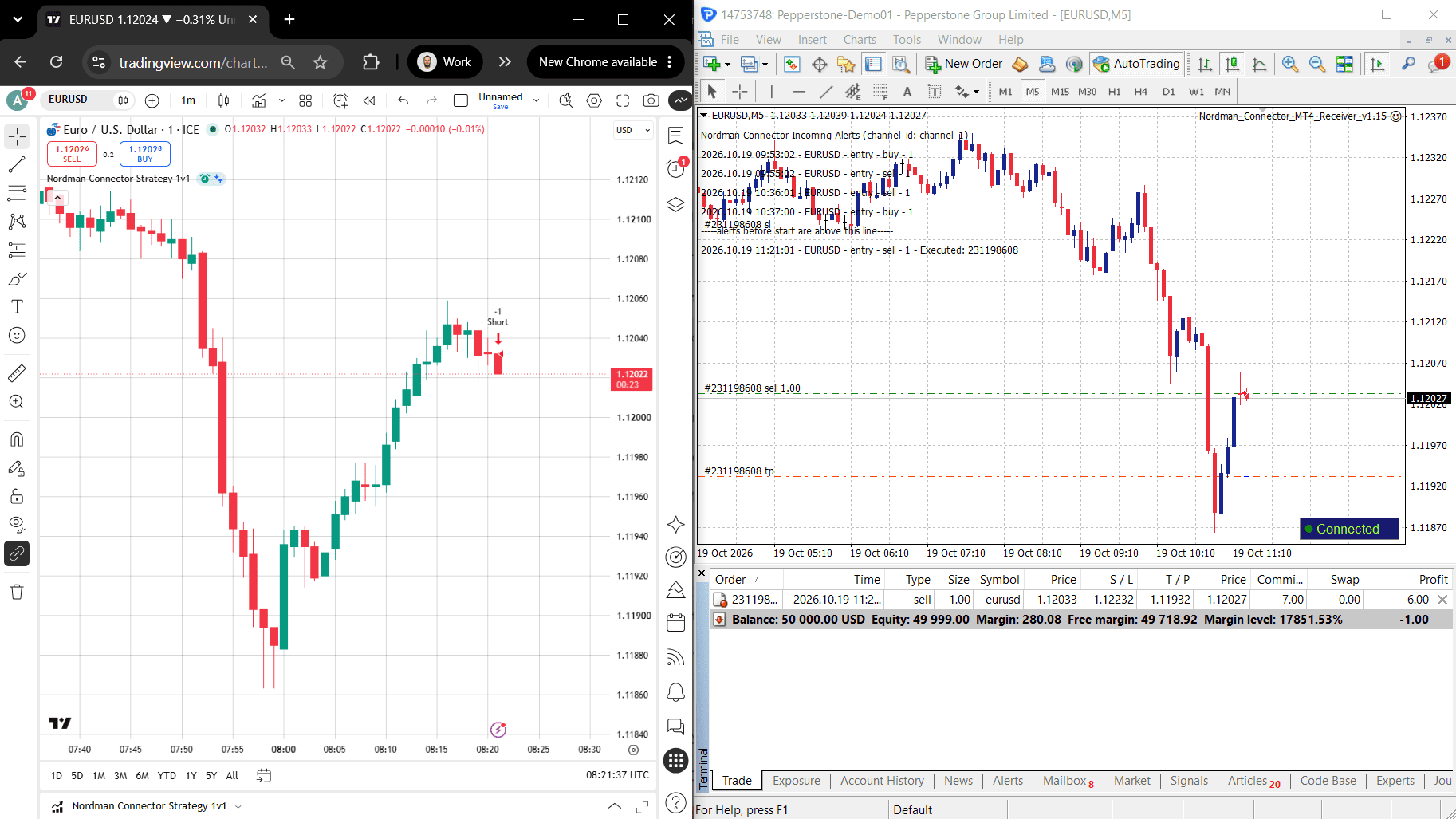
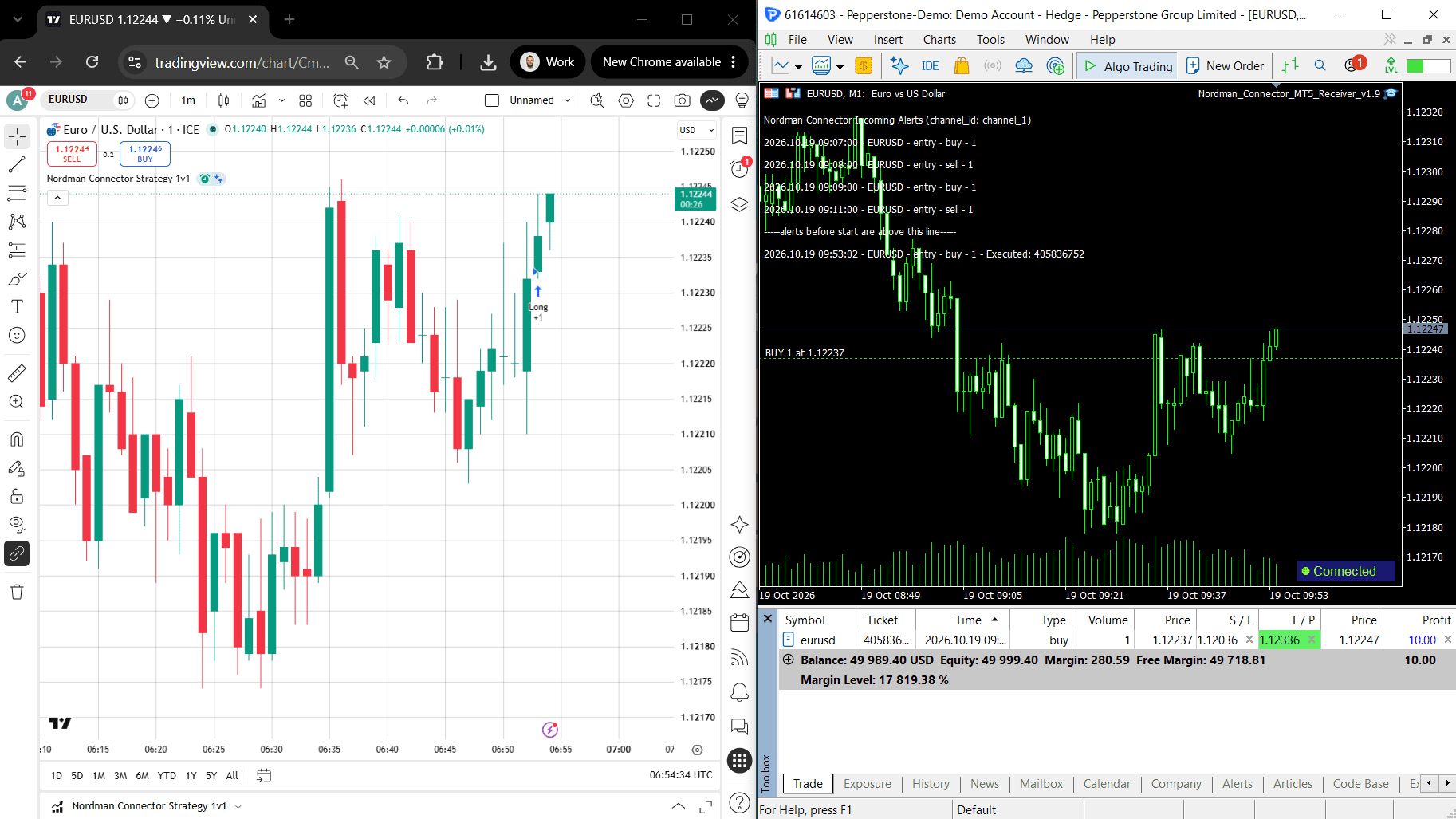
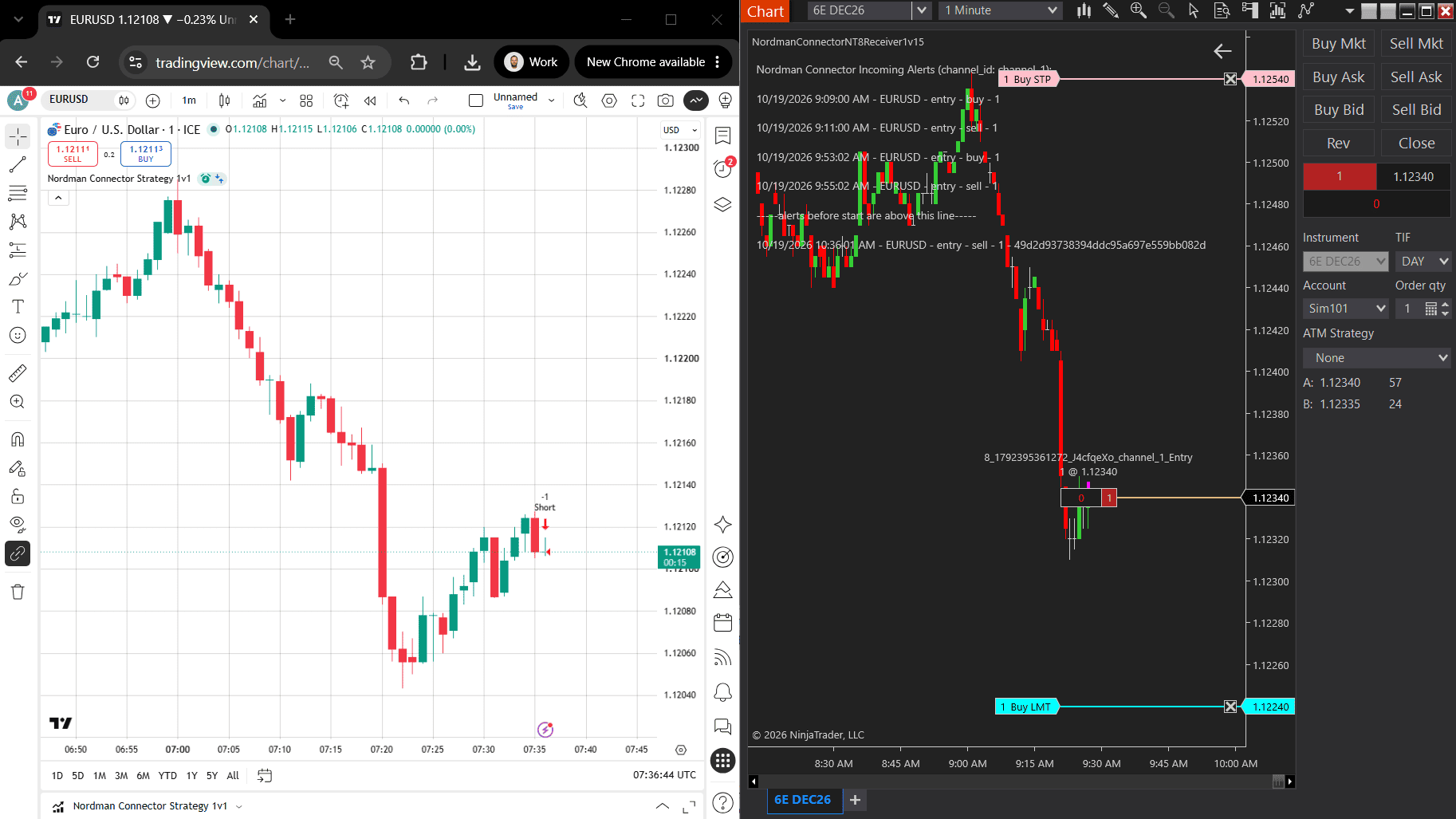
A TradingView alert channel can be connected to Receivers on cTrader, MetaTrader 4, MetaTrader 5 and NinjaTrader 8 at the same time, so one alert is executed on all of your connected terminals. Receivers for every platform are included in the same subscription.
Demo & Live Account Support
One license covers simultaneous use on one Demo and one Live cTrader account, verified by cTrader account number. Test your setup and validate behavior on demo while the live account runs in parallel — no additional license required for the pair.
Multiple Receivers Support
Connect several of your own cTrader Receiver cBot instances to the same TradingView signal source simultaneously. There is no limit on the number of connected accounts. Each connected cTrader account requires its own active license.
Independent cBot Instances & Channel Routing
Run multiple Receiver cBot instances within the same cTrader terminal, each with its own Channel ID, symbol, input settings, and unique position label. This allows separate TradingView workflows — different strategies or instruments — to operate independently without interfering with each other. Give each instance its own label in the Unique magic number setting.
No Symbol Mapping Required
Trades are executed on the cTrader symbol where the Receiver cBot is running, avoiding symbol-mapping issues between TradingView and cTrader.
Monitoring
Admin panel, chart and notificationsCentralized Admin Panel
Monitor incoming alerts, trade executions, connected cBot instances, and completed trades through the Nordman Connector admin panel. Each record includes signal identifier, direction, symbol, volume, entry price, TP/SL values, execution time, and status — giving you a complete alert and execution history for traceability and review.
Connection Status on the Chart
The Receiver cBot shows its connection status to the cloud server directly on the cTrader chart, so a lost connection is visible at a glance.
Telegram Notifications
Receive a Telegram notification through Nordman Connector when the cTrader Receiver cBot loses connection to the cloud server, helping you identify connectivity issues without continuously monitoring the terminal.
Prop Trading Limits
Optional limits on the Receiver — trading days, daily profit and loss, maximum spread in pips, maximum open trades, maximum open volume, and closing positions after a lost connection. Details are in the Prop Firm Controls tab.
Prop Trading Limits on the cTrader Receiver cBot
Optional risk controls for evaluation and funded accounts, configured in the risk-control settings of the cTrader Receiver cBot. Each limit can be enabled independently, and every incoming entry alert is checked against all enabled limits before it is executed.
Limits apply to new entries only. Exit signals for positions that are already open are still processed.
The limits count the Receiver’s own trades. Daily profit and loss, open trades and open volume are calculated for the cBot’s symbol and its position label — not for the whole cTrader account. The daily result combines the net profit of trades closed today with the current net profit of open positions.
Trading Days
Allow or disable trading for each day of the week, Monday to Sunday, based on the cTrader server time.
Daily Profit Limit
Stops new trading for the day once the Receiver’s daily result reaches your target.
Daily Loss Limit
Stops new trading for the day once the Receiver’s daily loss reaches your limit.
Maximum Spread (pips)
Checks the current spread of the symbol before every new entry.
Maximum Opened Trades
Caps the number of Buy and Sell positions the Receiver keeps open on its symbol at the same time.
Maximum Opened Units
Caps the combined Buy and Sell volume, in units, that the Receiver keeps open on its symbol.
Close All Trades on Disconnect
Optional · off by defaultA safety net for the cloud connection. When enabled, the Receiver records the moment it loses its connection to the server and waits for the configured timeout. If the connection is still unavailable, it closes the positions it manages — those with its position label on the cBot’s symbol.
Requirements & Setup
What you need to run the TradingView to cTrader Trade Copier, how the subscription and license work, and the steps from subscription to the first copied trade.
Requirements
- TradingView
- A TradingView account with webhook alerts — webhook alerts are available on paid TradingView plans
- Target platform
- cTrader Desktop — cTrader Receiver cBot
- Broker & account
- Any broker that offers cTrader with cBot execution
- Connection
- cTrader running with the Receiver cBot started and connected to the internet while alerts are expected; a VPS is optional
- cTrader permissions
- Full Access confirmed when the Receiver cBot is started — it needs network access to reach the Nordman servers
- Admin panel
- Access to nordman-connector.com, sent by email after registration
Live signals only. Alerts that arrive while the Receiver cBot is stopped or cTrader is offline are not queued or executed later.
Subscription & License
- All-Access Subscription
- This product is available on a monthly subscription basis. Access to all Nordman Algorithms indicators and trade copiers, billed monthly, renews automatically.
- Free trial
- 5 days. No charges apply during the trial period. If not cancelled within 5 days, the subscription starts automatically.
- Cancellation
- Cancel at any time. If you need help cancelling, contact us and we will assist you.
- One license = one Demo + one Live account
- Each license allows one demo and one live cTrader account to be connected at the same time, verified by cTrader account number. Every additional cTrader account needs its own license.
- Other platforms
- Receivers for MetaTrader 4, MetaTrader 5 and NinjaTrader 8 are included in the same subscription.
Setup
- Start the free trial or subscribe
Start the 5-day free trial or subscribe on this page. After registration, you will receive an email with your login credentials for the admin panel at nordman-connector.com.
- Download and install the Receiver cBot
The Receiver cBot is available through . Enter the email address used for your subscription, and the download will begin automatically once verified. Double-click the downloaded
.algofile, or open it with cTrader, to add the cBot to your cTrader installation. - Configure your TradingView alerts
In the admin panel, choose your workflow — Manual Trading, Strategy or Indicator, With Script Access (Low-Code) or No-Code Configuration — and set up the TradingView alerts with the webhook URL and the message provided for that workflow.
- Start the Receiver cBot
Add an instance of the Receiver cBot on the account and symbol you want to trade, enter your license email, your Public Key and the Channel ID used in your TradingView alerts, and start it. When cTrader asks for Full Access, confirm it. When you run several instances, give each its own value in Unique magic number — it is used as the position label. All Receiver settings are described in the Instructions tab.
- Test on a demo account
We strongly recommend testing the system on a demo account before using it on a live account. Make sure you fully understand how the system works and how it behaves under different market conditions.
Live accounts: only proceed after you are confident in its operation.
Step-by-step guide: detailed setup instructions for every workflow, with ready-to-use webhook messages, are available in the Help Center of the admin panel.
Questions, errors or issues while using the system? Contact support, Monday to Friday.
Setup Order & Receiver Settings
How the copier is configured, from the admin panel to the cTrader account, and what every setting of the cTrader Receiver cBot does. Detailed step-by-step instructions with ready-to-use webhook messages are available in the Help Center of the admin panel at nordman-connector.com.
- Keys
Find your Private Key and Public Key in the admin panel.
- Channel
Choose a Channel ID for each strategy or symbol you want to copy.
- Alerts
Create TradingView alerts with the webhook URL and the message for your workflow.
- Receiver
Start the Receiver cBot on your account and symbol and enter your email, Public Key and Channel ID.
- Telegram
Optionally, connect @NordmanConnectorbot and enter your Chat ID for connectivity notifications.
Step-by-step guide in the admin panel. Webhook URLs, ready-to-use alert messages and setup examples for every workflow are in the Help Center at nordman-connector.com. They are personal to your account and are not published on this page.
Open nordman-connector.com →cTrader Receiver cBot Settings
All settings of the Receiver cBot, grouped by purpose, with their default values.
Connection Settings
| Parameter | Default | Description |
|---|---|---|
| Your license email | — | The email address you used when subscribing to the service. It is used to verify your active license. |
| Public key of the sender | — | Your Public Key from the admin panel. It connects the Receiver to the alert channels of your account. |
| Unique ID of the alert channel | channel_1 | The channel from which alerts are copied. It must match the Channel ID configured in TradingView. Use a different Channel ID for each strategy or symbol so that separate instances work independently. |
Trade Settings
| Parameter | Default | Description |
|---|---|---|
| What the EA should do upon a reversal signal? | Close all on reverse | What the Receiver does when a new entry alert arrives while a position in the opposite direction is open: close all opposite positions before opening the new one, or open a hedge and keep the existing position. |
| Allow pyramiding | Off | When enabled, the Receiver adds to an existing position if a new entry alert in the same direction arrives. When disabled, same-direction entries are blocked while a Receiver-managed position in that direction is open. |
| Allow trading within this time (broker-based) | 00:00/00:00 | The time window during which incoming entry alerts are executed, based on the cTrader server time. Sessions that cross midnight are supported. 00:00/00:00 disables the restriction. |
Position Size Settings
| Parameter | Default | Description |
|---|---|---|
| Which lot size to use in each trade? | Signal lot size | Use the volume from the TradingView alert, or your own sizing method below. |
| Alert signal lot size multiplier | 1.0 | Scales the volume from the alert: 1.0 keeps the original size, 2.0 doubles it, 0.5 halves it. |
| My own lot size type | Risk-based | The sizing method used when your own size is selected: Fixed units, Risk-based or Balance-based. |
| Fixed units size | 1000 | The volume in units for every trade in Fixed mode. |
| Risk for risk-based lot size (% of account balance) | 1 | The percentage of the account balance used to calculate the volume from the Stop Loss distance. A non-zero Stop Loss is required — from the alert or from the Receiver’s own TP/SL settings. |
| Use this units size / Per each this $ amount | 1 / 10,000 | Balance-based sizing: the volume in units used per amount of account balance. |
Take Profit / Stop Loss Settings
| Parameter | Default | Description |
|---|---|---|
| Which take profit and stop loss to use in each trade? | From the alert signal | Use the TP and SL values from the TradingView alert, or your own values set in the Receiver. |
| Add take profit to each trade | On | Enables or disables Take Profit. |
| My own take profit (ticks) | 100 | Your Take Profit distance in ticks when the Receiver’s own TP/SL settings are selected. |
| Add stop loss to each trade | On | Enables or disables Stop Loss. |
| My own stop loss (ticks) | 100 | Your Stop Loss distance in ticks when the Receiver’s own TP/SL settings are selected. |
Prop Trading Limits
| Parameter | Default | Description |
|---|---|---|
| Enable trading days filter / Enable Monday–Sunday | Off / all days on | Allows or disables new trades for each day of the week, based on the cTrader server time. |
| Enable daily profit limit / Max daily profit | Off / 500 | Blocks new entry alerts when the day’s result for the cBot’s symbol and position label reaches the maximum profit. The result combines trades closed today with the current net profit of open positions. |
| Enable daily loss limit / Max daily loss | Off / 500 | Blocks new entry alerts when the same daily result reaches the loss limit. |
| Enable maximum spread filter / Max spread (pips) | Off / 2.0 | Blocks a new entry while the current spread is at or above the set value. |
| Enable maximum opened trades filter / Maximum opened trades | Off / 5 | Blocks new entry alerts while the number of open Buy and Sell positions for the cBot’s symbol and position label is at or above the limit. |
| Enable maximum opened units filter / Maximum opened units | Off / 10 | Blocks new entry alerts while the combined open Buy and Sell volume, in units, for the cBot’s symbol and position label reaches the limit. |
| Close all trades on disconnect / Disconnection timeout seconds | Off / 20 | Closes the positions with the Receiver’s position label on the cBot’s symbol if the connection to the cloud server is not restored within the timeout. |
General Settings
| Parameter | Default | Description |
|---|---|---|
| Unique magic number | 123456 | Used as the label of the positions the Receiver opens, so it can identify its own positions and closed trades for trade management and the Prop Trading Limits. Give each Receiver instance its own value. |
| Enable extended logging | Off | Prints additional diagnostic information to the cTrader log. Our support team may ask you to enable it when investigating an issue. |
Frequently Asked Questions
Workflows & Setup
Yes. The copier supports manual trade triggering from TradingView using alerts configured for Entry Buy, Entry Sell, Exit Buy, and Exit Sell actions. When you activate the corresponding alert, the signal is sent through the webhook connection and processed by the cTrader Receiver cBot.
With Script Access (Low-Code) workflows are designed for users who can edit Pine Script strategies or indicators and configure alert logic inside the source code. No-Code Configuration workflows are designed for users who prefer not to modify Pine Script or do not have access to the source code.
Yes. Protected and closed-source TradingView indicators can be used when they expose alert conditions that can be selected through the TradingView alert interface.
No. The Receiver cBot is preconfigured and ready to use — no cAlgo coding required. For TradingView, No-Code Configuration lets you set up alerts without editing Pine Script using the ready-to-use webhook message from the client area.
Yes. The copier supports automated TradingView strategy alerts. In No-Code strategy workflows, the Receiver can process first entries, scale-ins, reversals, full closes, and proportional partial exits based on strategy position-state changes.
Yes. TradingView indicator alerts can be connected to the cTrader Receiver cBot using either With Script Access (Low-Code) or No-Code Configuration workflows.
It depends on the workflow. With Script Access (Low-Code) workflows can use explicit Entry Buy, Entry Sell, Exit Buy, and Exit Sell alert logic. No-Code strategy workflows can use the strategy order and position-state information contained in TradingView alerts.
The copier receives signals through TradingView webhook alerts. Webhook alerts are available on paid TradingView plans, so a plan that supports them is required.
Both keys are shown in your admin panel. The Private Key is used only in TradingView alert settings to send signals to your channel — do not share it with anyone. The Public Key is entered in the Receiver on each of your terminals so it can receive the signals from your channel.
The Receiver cBot connects to the Nordman Connector cloud server and verifies your license over the internet, which requires Full Access rights in cTrader. Confirm the request when you start the cBot.
Execution
The Receiver can be configured to close existing opposite-direction positions before opening the new trade, or to open a hedge instead. Pyramiding can also be enabled or restricted separately.
Yes, for No-Code TradingView strategy workflows. The Receiver can process scale-in events and calculate proportional partial exits from the previous and current TradingView strategy position size.
Signal processing and order placement typically complete within approximately one second. The Receiver checks the cloud connection on a 500 ms timer; actual end-to-end execution time can vary depending on internet connectivity, cloud response time, broker execution conditions, and the TradingView webhook delivery time.
Yes. A Receiver cBot instance must remain active and connected to the internet to receive and execute incoming TradingView signals. If the cBot is stopped or cTrader is offline when an alert fires, the signal will not be replayed after reconnection.
By default, positions stay open. You can enable Close all trades on disconnect in the Receiver settings: if the connection to the cloud server is not restored within the set timeout (20 seconds by default), the Receiver closes the positions it manages on its symbol. The connection status is also shown on the cTrader chart, and you can receive a Telegram notification when the Receiver loses its connection.
A VPS is not required but is strongly recommended for automated workflows. It keeps the cTrader terminal and Receiver cBot running around the clock, reducing missed signals due to local machine shutdowns or internet outages.
Yes. TP and SL can be taken from the TradingView signal or replaced with values configured inside the cTrader Receiver cBot. TP and SL can also be enabled or disabled independently.
You can use the incoming TradingView signal size with a multiplier or override it in the Receiver. Receiver-side sizing supports fixed units, risk-based sizing as a percentage of account balance, and balance-based sizing. Risk-based sizing requires a non-zero Stop Loss.
Optional controls include permitted trading days, trading-session time, daily profit limit, daily loss limit, maximum spread in pips, maximum number of open trades, maximum open volume, pyramiding restriction, and connection-based position closing. The daily limits count the Receiver’s trades closed today together with its open positions.
Accounts & Licensing
Yes. Each Receiver instance can use its own Channel ID, cTrader symbol, settings, and unique position label, allowing separate TradingView workflows to be isolated from one another. Give each instance its own value in the Unique magic number setting — it is used as the position label.
Yes. Several of your own Receiver cBot instances can be connected to the same channel and execute the same alert. There is no limit on the number of connected accounts. Each cTrader account outside the included Demo + Live pair requires its own active license.
Yes. One TradingView alert channel can be connected to Receivers on cTrader, MetaTrader 4, MetaTrader 5 and NinjaTrader 8 at the same time. Receivers for every platform are included in the same subscription.
One license covers one Demo cTrader account and one Live cTrader account at the same time, verified by cTrader account number. Each additional cTrader account outside that included Demo + Live pair requires its own active license.
Yes. The Receiver cBot is designed for brokers that support the cTrader platform and cBot execution. Install the Receiver in your cTrader environment and start an instance for the account and symbol you want to trade.
It depends on the firm, and firms change their rules, so check your firm’s current terms before you connect a funded account. The Receiver runs under your own cTrader login, and its optional prop trading limits help you avoid breaking a rule by accident. They don’t make automated execution allowed where a firm bans it. More in Automated Trading on Prop Firm Accounts.
Yes. A 5-day free trial is available so you can test the copier before continuing with a paid subscription.
Yes. Your subscription provides access to all products available on the Nordman Algorithms website. You can use other Nordman Algorithms tools under the same subscription without purchasing additional licenses.
Related Products
Disclaimer — Software Use & Risk Disclosure
Nordman Algorithms is a trade name of Nordman Algorithms OÜ (Reg. No. 14435535), registered in Tallinn, Estonia.
Software Use
Software Nature & User Responsibility — Nordman Algorithms provides software tools only and is not liable for risks associated with trading activities conducted using the software. All trading actions, configurations, and trade copying processes are initiated and controlled solely by the user.
No Financial Advice or Regulated Services — Nordman Algorithms does not provide financial advice, trading signals, investment recommendations, managed copy trading services, or any other regulated financial products or services.
Software Function & Signal Execution — The software is a technical utility that automates the execution or replication of user-defined trading signals between supported platforms and trading accounts. Signals may originate from user-configured alerts, trading algorithms, indicators, strategies, expert advisors, or other automated systems defined by the user. The software solely transmits or executes these user-originated signals and does not generate, modify, analyze, or manage trading decisions independently.
Accuracy & Performance Disclaimer — Nordman Algorithms does not guarantee the accuracy, completeness, reliability, or trading performance of any software outputs, signals, or execution results.
Third-Party Platforms & Connectivity — Nordman Algorithms is not responsible for failures or delays caused by third-party platforms, user-side hardware or terminal availability, broker execution conditions, server availability, or external services used in conjunction with the software.
Read the full Terms of Service →Risk Disclosure
Trading Risk Warning — Futures, Forex, and options trading involve significant risk. An investor could potentially lose all or more than the initial amount committed. Risk capital is money that can be lost without jeopardizing financial security. Only risk capital should be used for trading. Past performance is not indicative of future results.
ESMA Risk Warning — Financial instruments, especially those involving leverage such as CFDs and Forex, are complex and carry a high risk of rapid financial loss. Our software provides technical automation based on user-defined conditions and does not mitigate or reduce inherent market risks.
CFTC Rule 4.41 — Hypothetical or simulated performance results have inherent limitations. Unlike actual performance records, simulated results do not represent real trading. Simulated results are also subject to the benefit of hindsight. No representation is being made that any account will achieve profits or losses similar to those shown.
Read the full Risk Disclosure →Trademark Notice — cTrader is a trademark of Spotware Systems Ltd. Nordman Algorithms is an independent software developer and is not affiliated with, sponsored by, or endorsed by Spotware Systems Ltd. References to cTrader identify software compatibility. TradingView is a trademark of its respective owner; Nordman Algorithms is not affiliated with or endorsed by TradingView.
Need a different setup?
If the standard TradingView to cTrader Trade Copier does not fully meet your requirements, we can customize and extend it to fit your trading workflow. Share the features you would like to add or improve, and our developers will propose a suitable technical solution.
Need alert logic in your script? We can add the alert conditions and messages your Pine Script strategy or indicator needs to work with the copier.