Nordman Algorithms · Technical review by Alexei Kuntysh, founder
ICT kill zones are almost always quoted as fixed New York times, with London running from 2 to 5 AM and New York from 7 to 10 AM, and for most of the year that shorthand does its job. It works because London and New York move their clocks within a few weeks of each other, so the five hours between the two cities stay five hours. Between those two changes the gap shrinks to four. This autumn that happens from 26 to 30 October 2026, and next spring it lasts two weeks, from 15 to 26 March 2027.
The London box is still drawn at the same New York hours in those weeks. The London open inside it lands an hour later than usual, at 4 AM instead of 3, and nothing on the chart points that out. Below are the exact dates, what the shift does to the box and its pivots, and a NinjaTrader time zone setting that can leave a chart an hour off for the whole winter.
ICT writes kill zones in New York time, but each one is built around another market’s opening. The London window starts an hour before London’s trading desks and stock exchange open at 8 AM local time. It runs through their first two hours, which the method treats as the most active part of the night. Many ICT traders watch it for a sweep of the range that Asia left behind. So 2 to 5 AM is shorthand for “an hour before London opens until two hours after”, and the shorthand is only right while London is five hours ahead.
The EU and the UK change their clocks on the last Sunday of March and October, while the US changes on the second Sunday of March and the first Sunday of November (NIST). In autumn Europe goes first and in spring America does, and for the days in between London is only four hours ahead of New York. The “Frankfurt open” column is the mark ICT traders put an hour before London, at 8 AM Frankfurt time.
| Period | London open (8 AM London) in New York time | ICT “Frankfurt open” in New York time | London open inside a 2–5 AM box |
|---|---|---|---|
| Until 23 Oct 2026 | 3 AM | 2 AM | 1 hour in |
| 26–30 Oct 2026 (Europe on winter time, US still on summer time) | 4 AM | 3 AM | 2 hours in |
| 2 Nov 2026 – 12 Mar 2027 | 3 AM | 2 AM | 1 hour in |
| 15–26 Mar 2027 (US on summer time, Europe not yet) | 4 AM | 3 AM | 2 hours in |
| From 29 Mar 2027 | 3 AM | 2 AM | 1 hour in |
In a normal week the London box opens with Frankfurt at 2 AM and London comes in an hour later. That leaves two hours of the box to watch London’s first push. In the gap weeks Frankfurt opens at 3 AM, London at 4 AM, and only one hour of the box remains once London is trading. The first two hours cover the European pre-open, which is usually the thinner part of the night. If you plot the box’s high and low as pivots, they are built mostly from those quiet hours that week, with London’s first hour squeezed in at the end.
Here is the same 6E chart on five-minute bars in two different weeks. Its clock is set to a European time zone one hour ahead of London, so London’s 8 AM open reads 9:00 in both screenshots.
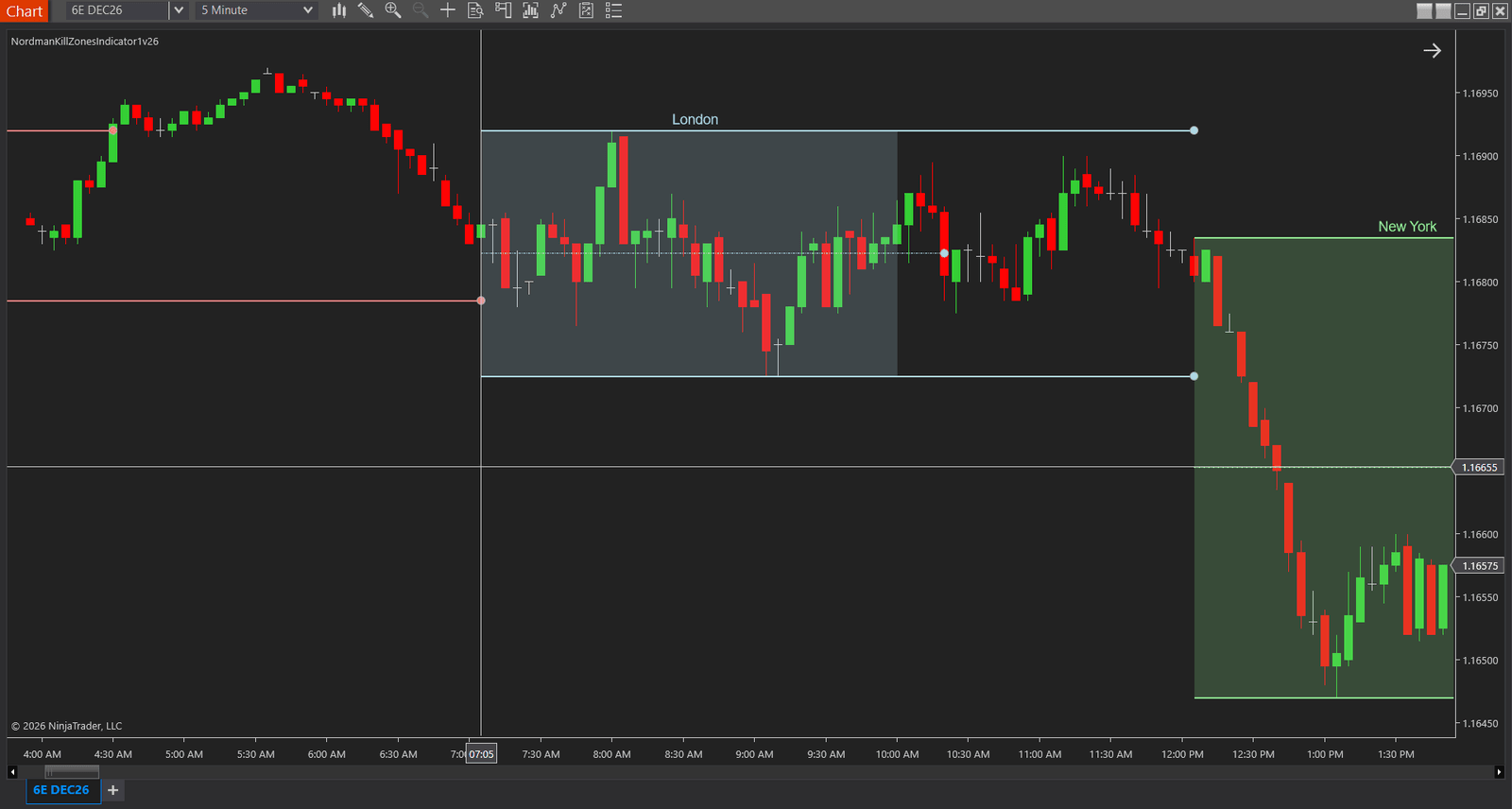
In the gap week the London box starts at 7:00 on this chart. London opens at 9:00, two hours in, and gets the last hour of the box. The New York box starts at 12:00.
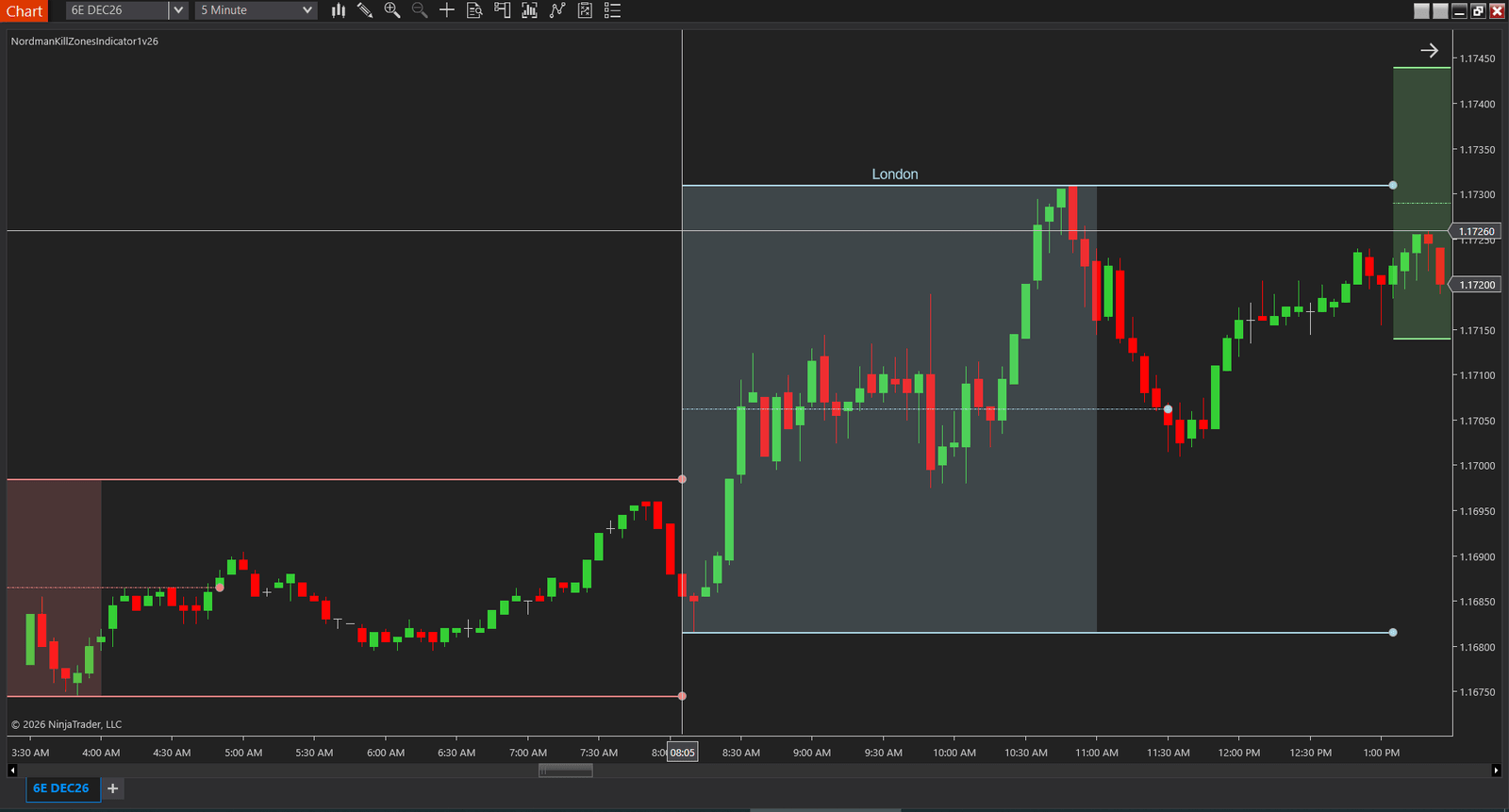
In a normal week the box starts at 8:00, so London opens one hour in and has two hours of the box. The New York box starts at 13:00. Both boxes moved by an hour on this chart because New York changed its clock. London’s open stayed at 9:00.
How much this matters depends on what your rule is about. Say your edge is tied to the New York clock, for example because it’s about overnight liquidity before US traders arrive. Then nothing has changed. If your edge is tied to London coming in, that week’s box holds only one hour of London, right at its end.
The indicator itself needs no adjusting. It keeps its sessions on New York’s clock and switches between winter and summer time automatically, so the London box sits at 2 to 5 AM New York time every week of the year. What changes in the gap weeks is the market inside it. For that reason we’d give that week’s box pivots less weight than usual.
Japan doesn’t use daylight saving time, so Tokyo’s 9 AM open moves against New York every spring and autumn. From November to March it falls at 7 PM New York time, and for the rest of the year at 8 PM. An Asia box set at 19:00 to 22:00, as in the settings below, starts on the Tokyo open in winter and an hour ahead of it in summer. That shift lasts about eight months a year, far longer than the London gap. It gets noticed less because there’s no single week when it changes. Here too nothing needs changing in the indicator: it’s the Tokyo open that moves against the box.
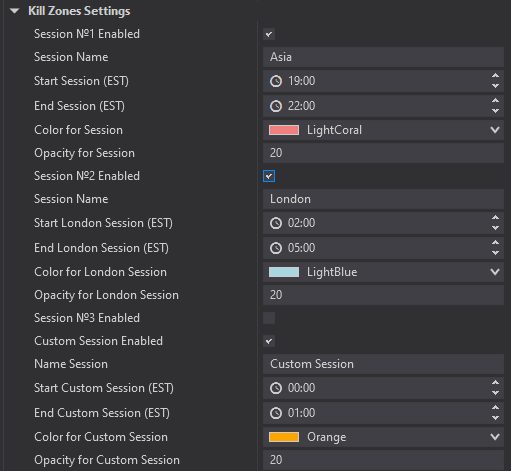
The panel labels the session times EST, which is how Windows names New York’s time zone all year round, summer included. The same naming habit trips people up in NinjaTrader’s own time zone list.
In a NinjaTrader forum thread from June 2026, one user couldn’t find New York’s summer time in the list. So they picked another city: “there is only newyork utc-5 which is winter . there must be EDT newyork -4UTC. can t find it in ninjatrader , so i chose caracas,venezuela -4UTC” (stec_der, NinjaTrader Forum, Jun 2026).
NinjaTrader’s time zone list uses the Windows zone names. Windows labels New York’s zone “(UTC-05:00) Eastern Time (US & Canada)” all year, although the zone itself moves to UTC−4 every summer. Caracas sits at UTC−4 with no daylight saving at all. In June the two cities show the same time, so the chart looked right. From 1 November New York drops back to UTC−5 while Caracas stays where it is. Until March, every bar on that chart will read an hour later than New York.
The first reply asked: “Is there an option for daylight savings that you are missing?” (Rockmanx00, NinjaTrader Forum, Jun 2026). In effect there is, because the Eastern Time zone already includes it. For anyone writing session times into their own NinjaScript, a developer in an older thread gave the general rule. Their advice is to “create your custom trading hours in the exchange time zone, much like the built-in templates do”, and seasonal offsets are then “handled automatically” (Steve_NinjaMastery, NinjaTrader Forum, Jul 2025).
The same applies if you trade from Europe or Asia. Choose the named zone for your own city under Tools → Options → General, and avoid a different city that only happens to share today’s offset. The Kill Zones indicator reads that setting too and converts its New York sessions into whatever zone NinjaTrader uses, so a correct zone there is all it needs.
If you want to see where London actually opens, a custom session can mark it as its own block. We don’t have a screenshot of that setup yet, so the one below shows the same feature with a midday window from 12:00 to 14:00, drawn in orange next to the regular sessions.
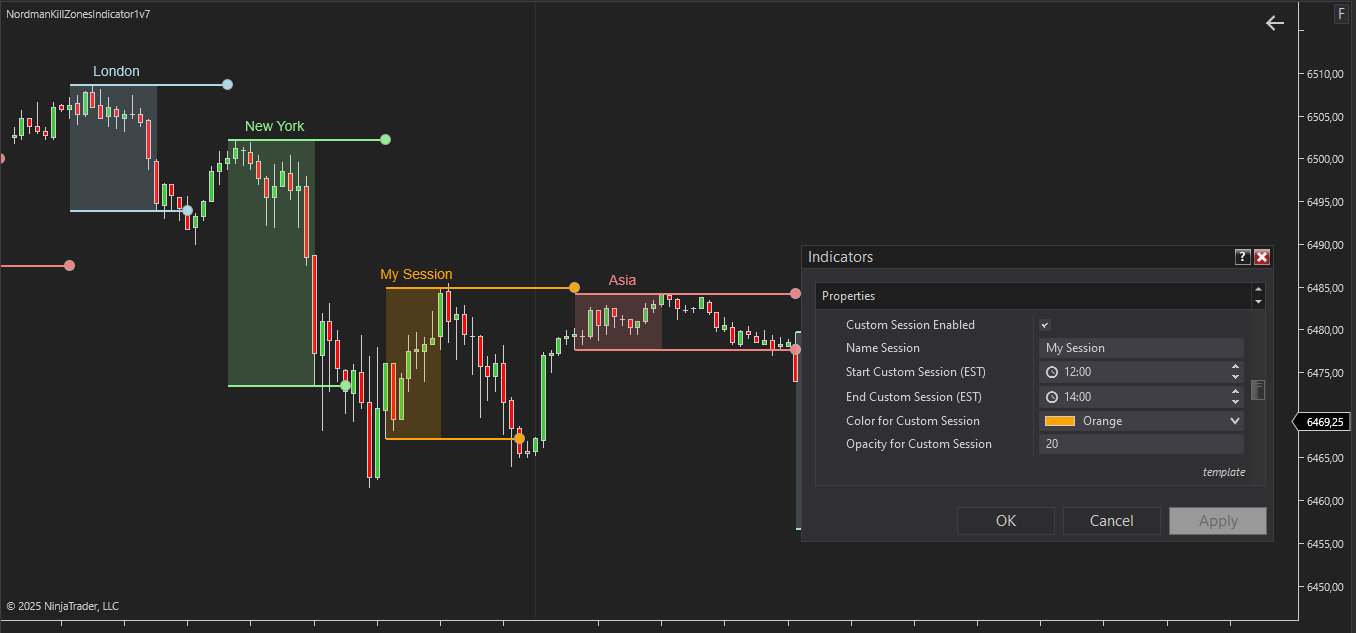
For London’s first hour you’d set it to 03:00 to 04:00 New York time. On a 5-minute chart of a market that trades through the European morning, such as 6E or FDAX, the volume jump at London’s first bar sits at the left edge of that block for most of the year. In the gap weeks it lands an hour later, right where the block ends, which is the clock change showing up on your own chart. If the jump is somewhere else entirely, the platform’s time zone is the first thing to check.
For three weeks a year the London kill zone and the London open disagree, and for most of the year the Asia box and the Tokyo open do. What matters is knowing, before 26 October, whether your rule follows New York’s clock or another market’s opening, and reading that week’s boxes with it in mind.
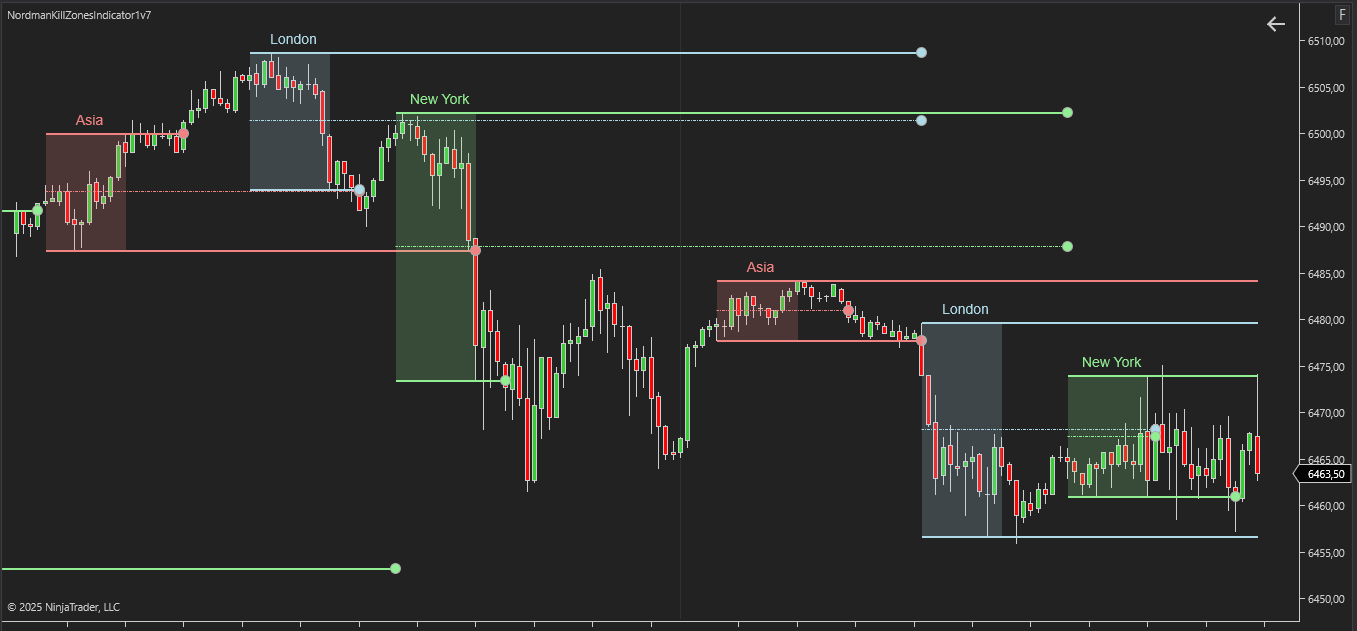
The NinjaTrader Kill Zones Indicator draws the Asia, London and New York sessions plus one custom session, with session pivots and the day open. You can run it on the €25 monthly plan, which also unlocks our other indicators and the trade copiers and starts with five free days. A single licence for this indicator costs €175 once.
See the Kill Zones Indicator →
Need something custom built? We develop automation to order → NinjaTrader developers
In ICT’s usual definition it runs from 2 to 5 AM New York time, around the London open at 3 AM. In the weeks when Europe and the US are on different clock settings, London opens at 4 AM New York time. Those are 26 to 30 October 2026 and 15 to 26 March 2027.
The named zone for your own city. For New York that’s Eastern Time (US & Canada), which switches to summer time automatically even though its label shows UTC−05:00.
Nordman Algorithms provides software infrastructure for trade automation and does not offer financial advice, trading signals, or managed trading services. Session boxes and pivots are drawn from predefined time windows and price data and do not constitute a recommendation to buy, sell, or hold any instrument. This article is for informational and educational purposes only. Chart screenshots illustrate indicator behaviour on historical data and are not a record of trading results. Session times and clock-change dates are given for 2026 and 2027 and may change if the rules change. Forum quotations are reproduced verbatim from public threads for illustration and do not constitute endorsement. Trading leveraged instruments such as Forex, CFDs and futures carries a high level of risk and may not be suitable for all investors. Only risk capital should be used. Full Risk Disclosure: https://www.nordman-algorithms.com/risk-disclosure/