A Forex Expert Advisor (EA) is an automated trading program built on the MetaTrader platform — or a functionally equivalent automated strategy on NinjaTrader, cTrader, or other platforms — that executes rule-based logic without manual intervention. This article covers the key questions traders have about Forex EAs, how they work, and how to approach developing one.
A Forex EA, or Expert Advisor, is a software program that monitors market data and executes trades automatically based on a predefined set of rules. EAs operate on rule-based logic — they evaluate defined technical conditions and, when those conditions are met, execute the corresponding order logic according to the programmed parameters.
The term Expert Advisor applies specifically to MetaTrader, but equivalent automated strategy software can be developed for NinjaTrader, cTrader, TradingView, TradeStation, and other platforms. These systems are also referred to as mechanical trading systems, algorithmic trading strategies, or trading robots.
Automated strategies offer several operational advantages: they can monitor multiple instruments continuously, execute order logic consistently without manual intervention, and operate across market sessions without requiring the trader to be present.
A Forex EA processes live market data — price, volume, and derived indicators — against a set of programmed conditions. When all defined conditions are met, the EA triggers the corresponding action: submitting an order, modifying a position, or closing a trade, depending on the logic defined in the code.
The EA evaluates data on each new bar or tick, depending on how it is configured. It applies the rule set sequentially — checking entry conditions, filter conditions, and position management parameters — and executes only when the full set of conditions is satisfied. The same logic governs exits, stops, and position sizing as defined in the original specification.
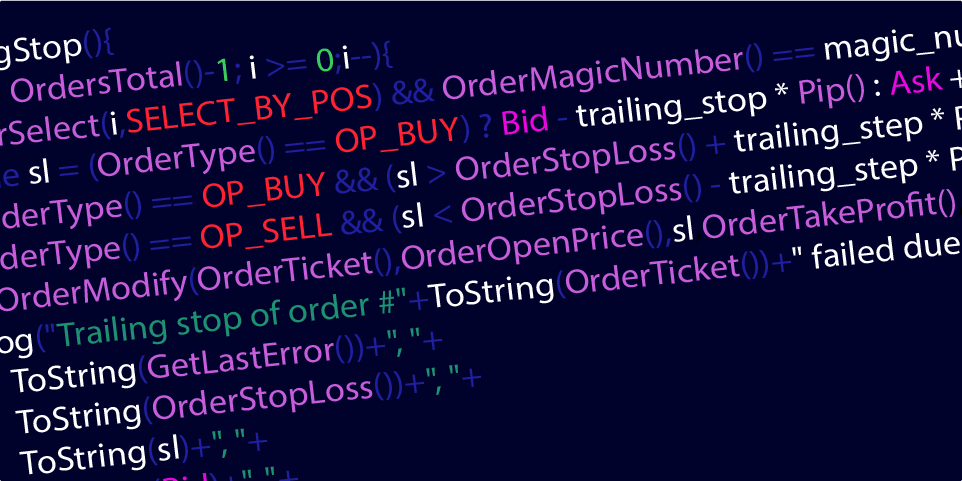
A Forex EA programmer is a software developer with experience building automated trading systems and working knowledge of trading platform architecture and their native programming languages.
A qualified Forex EA developer needs three core competencies. First, a thorough understanding of the target trading platform — MetaTrader 4, MetaTrader 5, NinjaTrader, cTrader, or another — including its execution model, order handling, and platform-specific limitations. Second, fluency in the platform’s native programming language: MQL4 or MQL5 for MetaTrader, NinjaScript for NinjaTrader, C# for cTrader, or Pine Script for TradingView. Third, familiarity with the structural requirements of trading systems — common logic issues, execution timing, and the types of bugs that affect automated strategy behavior.
Hiring a professional Forex EA developer rather than attempting to write the code independently has several practical advantages. An experienced Forex programmer already understands the execution model of the target platform, which directly affects whether a strategy behaves as intended during live operation.
Professional Forex EA programmers are familiar with the common logic errors that affect automated strategies — off-by-one bar issues, repainting, look-ahead bias in backtests, and order handling edge cases. Identifying and resolving these issues during development is significantly more efficient than diagnosing them after the system is in use.
Identify the market behavior your strategy is designed to capture — whether based on price patterns, indicator combinations, or time-of-day conditions. The clearer the observation, the more precisely it can be expressed as a rule set.
Choose the indicators, price levels, or data inputs that will be used to detect the conditions your strategy depends on. Include both the conditions that trigger action and the conditions that filter it.
Document every rule in your system in written form before development begins. Specify entry conditions, exit conditions, position sizing logic, and any filters or exceptions. The more precise the specification, the more accurately the developer can implement it.
Find a developer with verifiable experience building automated strategies on the target platform. Confirm that they understand your specification in full before development begins, and clarify any ambiguities during the scoping stage.
Once development is complete, test the strategy on historical data using the platform’s backtesting engine. Evaluate performance across different market conditions and time periods. Optimize parameters only after verifying that the base logic behaves correctly.
Run the strategy on a live demo account to confirm that it behaves consistently with the backtest results in real-time market conditions. Monitor for execution differences, slippage, and any edge cases that did not appear in historical testing.
Live deployment should follow only after both historical and forward-testing confirm consistent behavior. Continue monitoring performance after deployment to detect any changes in behavior under evolving market conditions.
We provide Forex EA programming and automated trading strategy development services for MetaTrader 4, MetaTrader 5, NinjaTrader, cTrader, TradingView, TradeStation, and other platforms. Our Forex EA developers work directly with MQL4, MQL5, NinjaScript, C#, Pine Script, and EasyLanguage.
Services include: Expert Advisor (EA) development for MetaTrader 4 and MetaTrader 5, automated strategy and custom indicator development for NinjaTrader 7 and 8, cBot and indicator development for cTrader, strategy and indicator development for TradingView and TradeStation, cross-platform conversions between any supported platforms, and modification or optimization of existing automated systems.
To discuss your project, request a free consultation. Our Forex EA developers will review your requirements, clarify the specification, and provide a development estimate with timeline and cost.