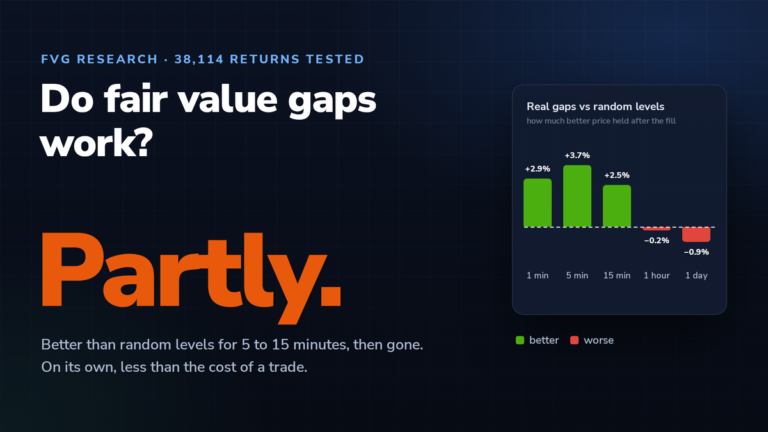
 Do Fair Value Gaps Work? We Tested 38,114 Returns to FVGsRead article →
Trade Copier, Account Rotator or Trade Queue: Running Multiple Prop Accounts in NinjaTrader 8
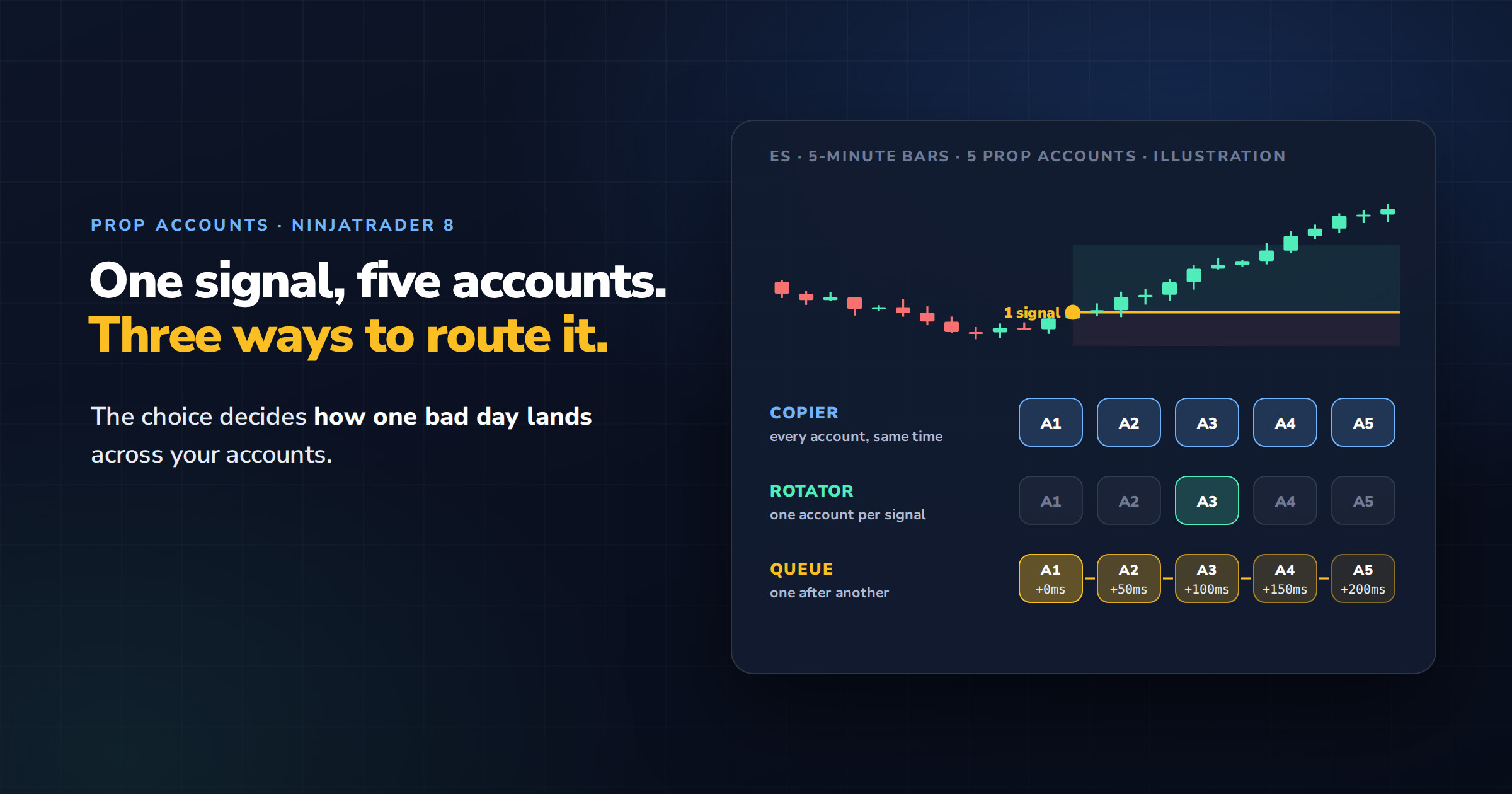
Once you run more than two or three prop accounts, the question stops being what to trade and becomes where each trade goes. Most traders start with a trade copier: one leader account, every follower mirrors it. Then the first bad morning takes out every account at once, and terms like “account rotator” and “trade queue” start to look interesting.
The three approaches route the same signal in different ways. A copier sends it to every account at the same time. A rotator sends it to one account. A queue sends it to the accounts one after another. None of them changes your strategy’s edge. They change how its losses land, how fills differ between accounts, and which prop firm rules you run into.
Below is how each model works in NinjaTrader 8, what it does to a losing streak, what the major futures prop firms allow as of late 2026, and when a ready-made tool stops being enough.
In This Guide
- Three ways to route one signal
- The trade copier: one decision, identical results
- The account rotator: same edge, different variance
- The trade queue: when “at the same time” isn’t
- Side by side
- The prop firm rules that decide for you
- Setting it up in NinjaTrader 8
- When a ready-made tool isn’t enough
- FAQ
Three ways to route one signal
Trade copier.A leader account places the trade, and every follower account mirrors it at the same time, scaled by a ratio if needed. One decision, as many identical positions as you have accounts.
Account rotator.Each new signal goes to one account only, the next one in a list, skipping accounts that are paused or done. The word is also used for a manual routine: trade one account until it hits its target, then move to the next.
Trade queue.The same trade goes to several accounts, but one after another rather than all at once, often with a rule that skips any account that has hit its daily limit. Sometimes sold as a “sequential copier”.
Hybrids.Real setups often mix them: a copier across a group of evaluations, rotation across funded accounts, and a queue that drops any account close to its drawdown. That’s usually where a ready-made tool stops fitting.
The trade copier: one decision, identical results
A copier is the simplest model and the one most firms describe in their rules. You trade one account, and the others follow. If your strategy works, every account earns. The catch is that every account also loses on the same trades, at the same moment. Five accounts on a copier aren’t five chances. They’re one chance, five times the size.
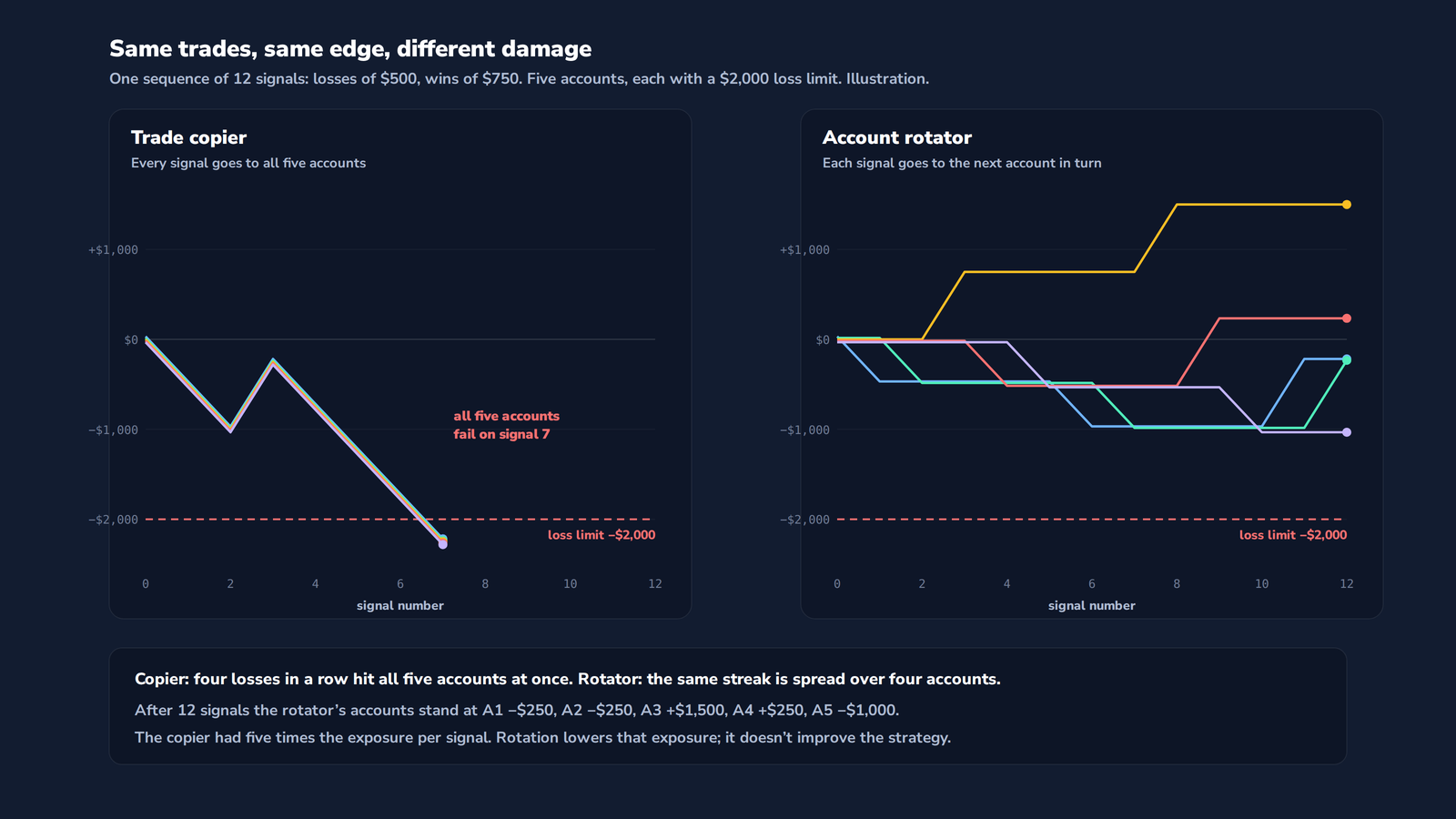
In the illustration each signal risks $500 and wins $750. Four losses in a row cost $2,000, which is the whole loss limit of each account. With a copier that streak hits all five accounts together, and all five fail on the same signal. The copier also had five times the exposure per signal, so on a good run it would have earned five times as much. That’s the trade-off in one sentence.
Two details catch copier users more often than the losing streak itself:
Different accounts, different limitsAn evaluation, a funded account and a larger account rarely share the same maximum contracts or drawdown. A ratio that suits the leader can push a smaller follower over its limit. One firm’s guidance is to make the account with the lowest position limit the leader.
Rules checked per accountConsistency rules, best-day limits and contract limits are usually checked for each account separately. One unusually large winner copied to ten accounts can put all ten in breach of a consistency rule at once.
The account rotator: same edge, different variance
A rotator sends each signal to one account in turn. In the same illustration, the four-loss streak lands on four different accounts, each of which takes a single $500 loss. After 12 signals all five accounts are still trading, standing between −$1,000 and +$1,500.
Nothing about the strategy improved. The rotator earns one account’s worth per signal instead of five, and over many signals its total result is the strategy’s result. What rotation changes is how the variance lands: a streak that ends five accounts on a copier costs each account one or two losses on a rotator. That makes accounts survive longer, and it makes each one progress more slowly, since every account only gets every fifth trade.
Rotation spreads risk across time, not across ideas. If your edge is real, rotation lets more accounts survive long enough to show it. If it isn’t, rotation just takes longer to fail.
The manual version, trading one account until it reaches its target and then switching, works on the same principle. You concentrate attention on one account and keep the others untouched until it’s their turn. It needs no software, only a record of which account is active.
One caution: a rotator isn’t copying, because each trade goes to one account. If the trades are generated automatically and routed by software, though, the firm’s rules on automated trading apply instead of its rules on copying, and those are often stricter.
The trade queue: when “at the same time” isn’t
Every copier sends orders to followers in some order. When they go out one after another, in a fast market each later account gets a slightly different price. On ES, where one tick is $12.50 per contract, a few ticks between the first and the last account add up quickly.
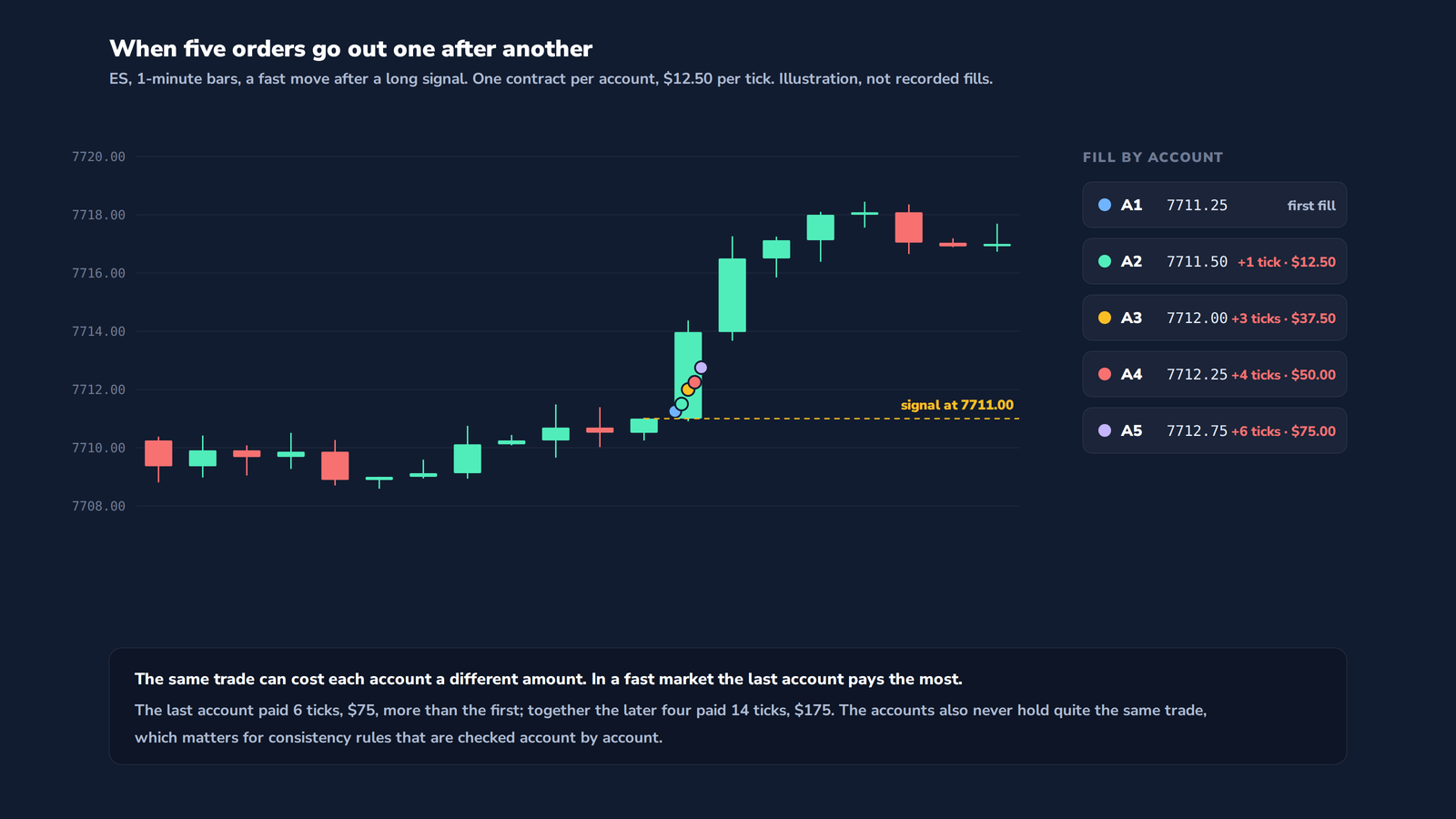
In the illustration the last of five accounts pays 6 ticks, $75 per contract, more than the first, and the later four together pay 14 ticks more. The five accounts also end up holding slightly different trades, which matters again for rules checked account by account.
A queue can also be a deliberate design. Some traders want trades to go to accounts in a set order and stop at any account that has hit its daily loss or profit limit, its maximum contracts, or its payout threshold. That’s useful, and it makes the order of the list part of the strategy, so it has to be decided on purpose rather than left to the software’s defaults.
Side by side
| Trade copier | Account rotator | Trade queue | |
|---|---|---|---|
| Exposure per signal | All accounts | One account | All active accounts |
| Losing streak | Hits every account at once | Spread across accounts | Hits every account still active |
| Fills | Close, but rarely identical | One fill per signal | Worse for later accounts in fast markets |
| Progress per account | Fastest | Slowest | Fast, uneven |
| Rule exposure | Copying and per-account rules | Automation rules if routed by software | Copying and per-account rules |
| Best fit | Proven strategy, firms that allow copying | Protecting accounts through drawdowns | Accounts at different stages and limits |
The prop firm rules that decide for you
Before choosing a model, read what each firm allows for each account stage. The rules differ more than most traders expect, and they change. A comparison checked against the firms’ own pages on 23 August 2026 found these differences (TradingFunder):
| Firm | Copying, as described on 23 Aug 2026 | Main limit |
|---|---|---|
| Apex Trader Funding | Allowed when the trader places each originating order manually and every follower belongs to the same trader | Followers must mirror the originating orders; automated origin falls outside |
| Topstep | Native copier for Trading Combine and Express Funded accounts | No copying for Live Funded accounts |
| Tradeify | Own or managed accounts only, all in the same direction | Five simulated-funded accounts per trader or household |
| Take Profit Trader | Test accounts and up to five PRO accounts | Five active PRO and PRO+ accounts combined |
| BluSky | Listed for evaluation, funded and live account types | No opposite positions in the same product |
The common ground is easier to remember than the details. Every account has to be yours. Followers shouldn’t take the opposite side of the leader, since that counts as hedging between accounts. The number of funded accounts is capped. And some firms allow copying only when the originating trade is placed by hand, which rules out an automated strategy as the leader.
Hiding automation doesn’t make it allowed. Some tools offer modes that remove automation markers from orders. If a firm doesn’t allow copying or automation for an account stage, disguising it is a breach of the agreement, not a workaround, and it puts the payout at risk rather than the evaluation fee.
Setting it up in NinjaTrader 8
NinjaTrader 8 can connect to several providers at once, so accounts from different firms, on Rithmic and Tradovate connections, can sit in one installation. That requires Multi-provider mode, which is switched on under Tools → Options (NinjaTrader Help Guide). With several connections, the connection order also decides which provider supplies market data, so it’s worth setting the preferred data connection on purpose (NinjaTrader Help Guide).
One tool per account.Never run two copiers or a copier and a rotator on the same account. Two programs managing one position produce duplicate orders and exits that one of them doesn’t know about.
Limits in every account.Set the daily loss, maximum contracts and flatten time for each account, not only on the leader. A follower with no limits of its own is only as safe as the leader’s next decision.
A plan for divergence.Rejected orders, a follower that missed an exit, a disconnect. Decide in advance how the tool detects an account that no longer matches, and how you flatten it by hand.
Test on simulation first.Run the whole setup on sim accounts for a few sessions, including a restart of NinjaTrader in the middle of an open trade, before any evaluation fee is at stake.
A VPS near the exchange keeps NinjaTrader running when your own computer is off, which matters more for a copier than for one account: a disconnect in the middle of a trade leaves every follower unmanaged at once.
When a ready-made tool isn’t enough
Off-the-shelf copiers cover the standard case well: one leader, followers with ratios. When the routing has to follow your own rules, we can build it to order in NinjaTrader 8, as a copier, a rotator, a queue or a combination of them. A custom build can include:
Sizing by account stageContracts per account set from its type, size and current drawdown, so an evaluation, a funded account and a larger account each trade within their own limits.
Rotation and queue rulesWhich account gets the next signal, which ones are skipped and why, and what happens when an account reaches its target or payout threshold.
Rule-aware risk controlsDaily limits, maximum contracts and flatten times per account, plus checks for consistency and best-day limits before a trade is sent, not after.
Signals from other platformsA leader on TradingView, MetaTrader 5 or another NinjaTrader instance, routed into several NinjaTrader accounts by the same rules.
Dashboards and logsOne view of every account’s P&L, drawdown and distance to its limits, and a log of what was sent where, for reviewing a day or answering a firm’s question.
Each of these is developed to your specification, for your accounts and the firms you trade with. You talk directly with the developer who writes your code, and the first consultation is free. Since 2018 our team has completed over 3,000 development projects for traders in more than 120 countries.
Discuss your prop account setup →
Prefer to start from the platform? → NinjaTrader developers
FAQ
What is the difference between a trade copier and an account rotator?
A copier sends every trade to every account at the same time. A rotator sends each trade to one account, the next in a list. The copier earns and loses on all accounts together; the rotator spreads both across accounts and over time.
Is copy trading allowed at prop firms?
At many futures prop firms, yes, between accounts you own and in the same direction, with limits on the number of funded accounts. Some allow it only for certain account stages or only when the originating trade is placed manually. Check the firm’s current rules for each account before you connect a copier.
Does account rotation improve results?
It doesn’t change the strategy’s edge. It reduces the exposure per signal, so a losing streak is spread across accounts instead of hitting all of them at once, and each account progresses more slowly.
How many prop accounts can NinjaTrader 8 handle?
NinjaTrader 8 can connect to several providers at once in Multi-provider mode, so accounts from different firms can run in one installation. The practical limits are usually the firms’ own caps on funded accounts and the stability of the computer or VPS running it.
Can you build a custom copier or account rotator for my prop accounts?
Yes. We develop copiers, rotators and trade queues to order in NinjaTrader 8, with the routing, sizing and per-account limits you specify, including signals that come from TradingView or MetaTrader 5.
Why do my copied accounts have different results?
Followers rarely fill at exactly the same price, especially when orders go out one after another in a fast market. Different contract ratios, rejected orders and accounts that missed an exit add to the difference.
Sources referenced in this article:
- NinjaTrader Help Guide, Enabling/Disabling Multi-provider Mode: ninjatrader.com
- NinjaTrader Help Guide, Multiple Connections: ninjatrader.com
- TradingFunder, Best Prop Firms for Copy Trading (firm policies checked 23 August 2026): tradingfunder.com
Nordman Algorithms provides software infrastructure for trade automation and does not offer financial advice, trading signals, or managed trading services. This article is for informational and educational purposes only. Prices, fills and account results in the examples are illustrations, not recorded trades. Prop firm rules are summarised from a third-party comparison dated 23 August 2026; they differ by firm and account stage and change over time, so check each firm’s current agreement before connecting any copier or automation. Compliance with a firm’s rules remains the account holder’s responsibility. Trading leveraged instruments such as futures carries a high level of risk and may not be suitable for all investors. Only risk capital should be used. Full Risk Disclosure
Related Articles
Do Fair Value Gaps Work? We Tested 38,114 Returns to FVGsRead article →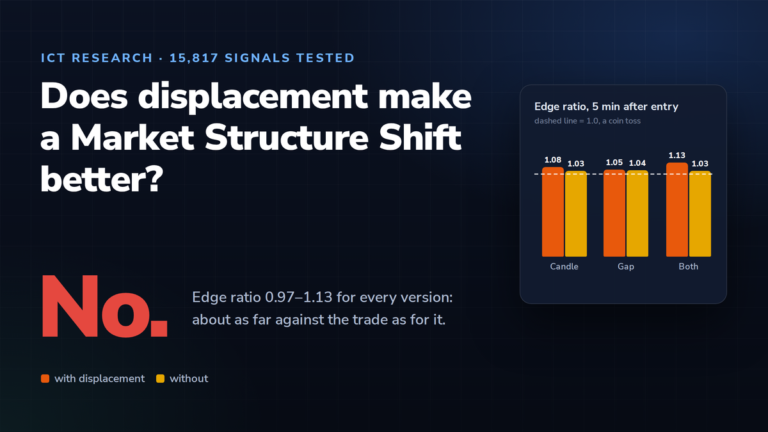 ICT Displacement and the Market Structure Shift: We Tested 15,817 SignalsRead article →
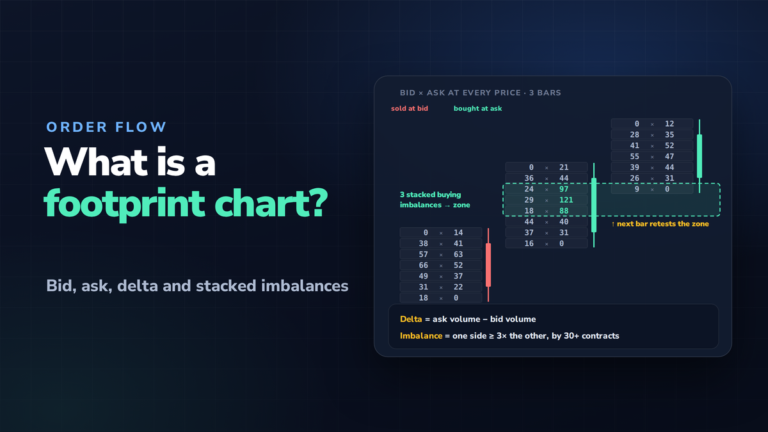 What Is a Footprint Chart? How to Read Bid, Ask, Delta and Stacked ImbalancesRead article →