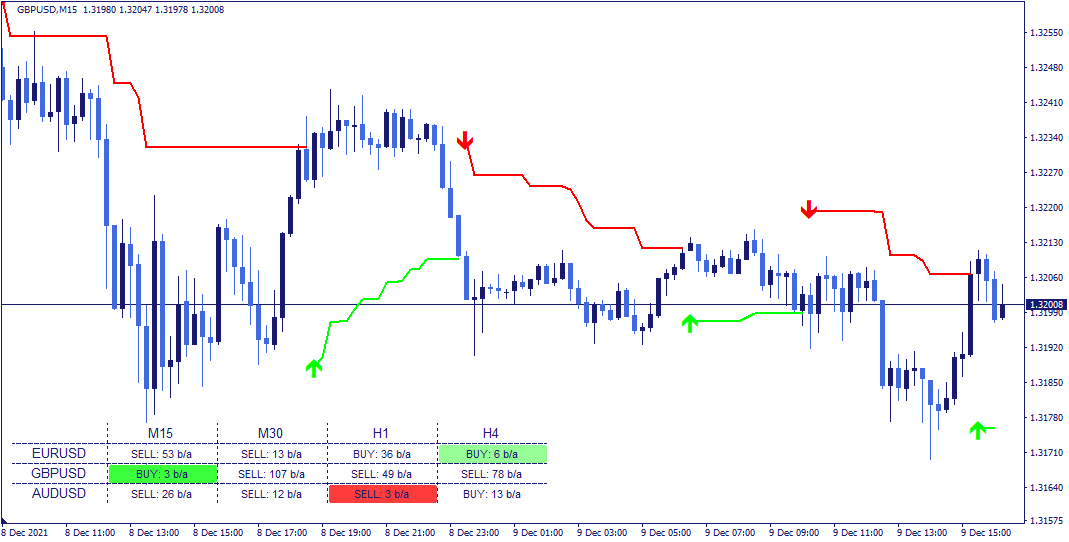
The SuperTrend Indicator evaluates whether the current trend structure is bullish or bearish — displaying this as a color-coded line and directional markers on the chart.
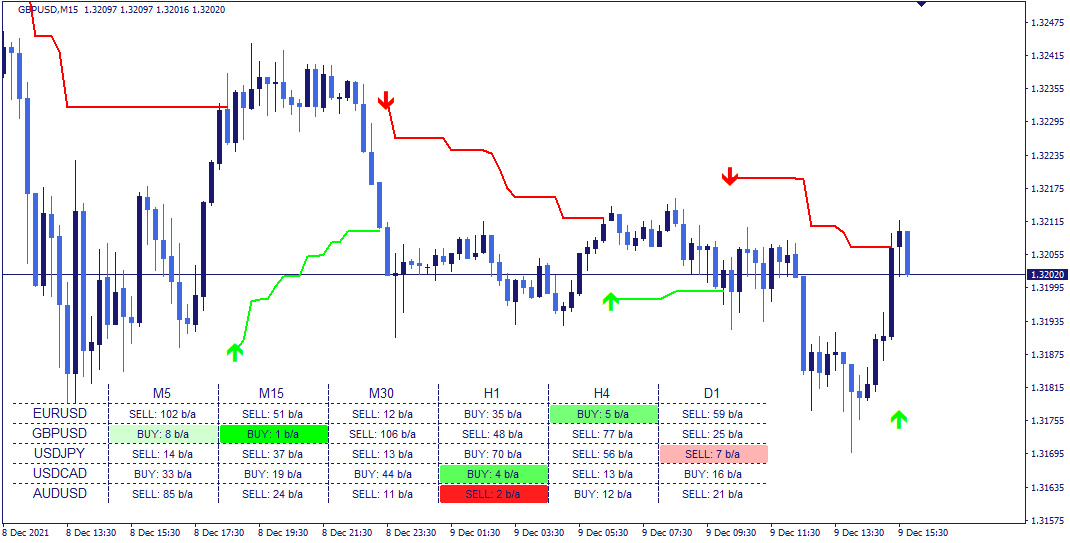
The technical analysis tool uses the Average True Range (ATR) indicator to calculate the current volatility of the asset. While ATR is not used to establish trends itself, it provides context for the strength of directional movement by measuring average price range over a defined period. Higher ATR values reflect wider average price movements — which the SuperTrend calculation uses to define the distance of the trend line from current price.
The indicator operates across all available timeframes — from M1 to MN — making it applicable within both short-term and long-term analytical approaches.
The indicator is implemented as a scanner that monitors all symbols and timeframes available in the MetaTrader 4 terminal for defined technical conditions. A built-in dashboard displays the current status of detected conditions across all monitored instruments and timeframes in a structured format. Clicking on any cell in the dashboard updates the chart to the corresponding instrument and timeframe directly — without opening a new window.
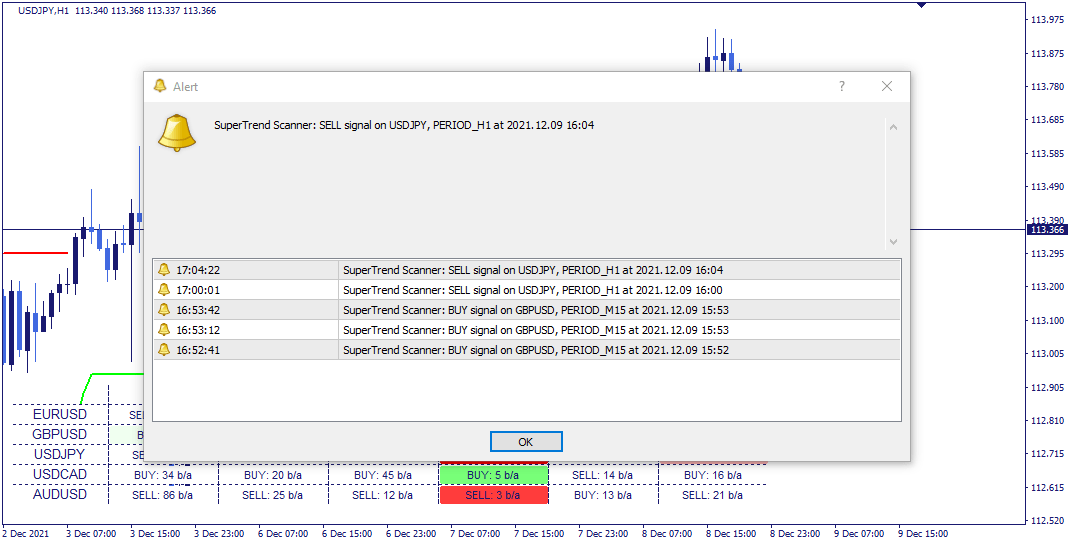
The indicator includes a configurable alert system that triggers a notification when a condition is registered or deregistered. Alerts can be delivered as sound notifications, email messages, or mobile push notifications — each configurable independently.
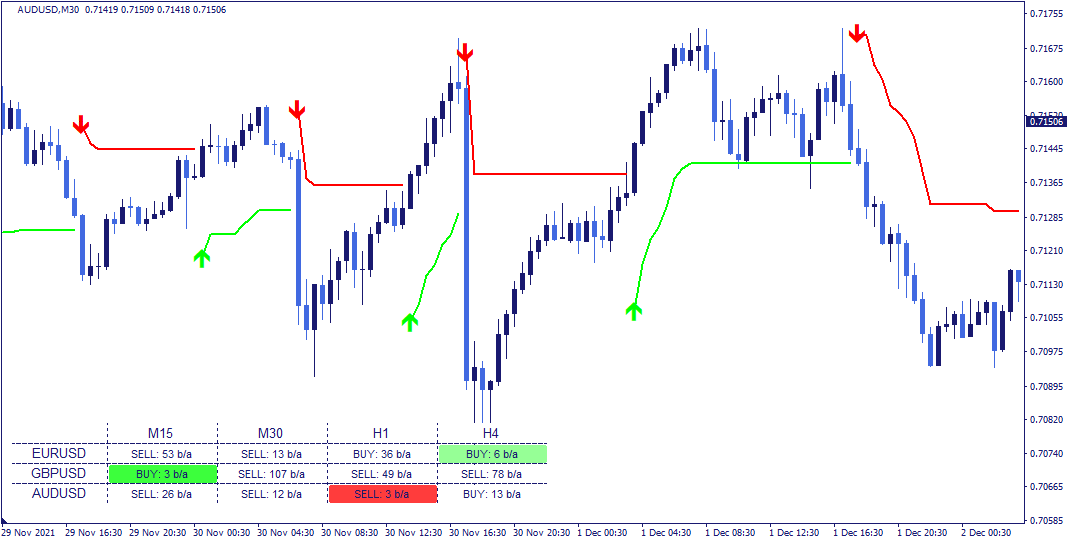
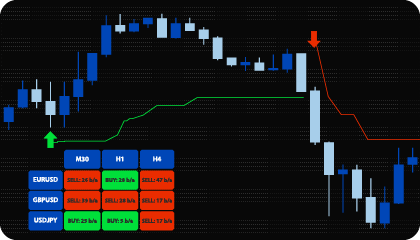
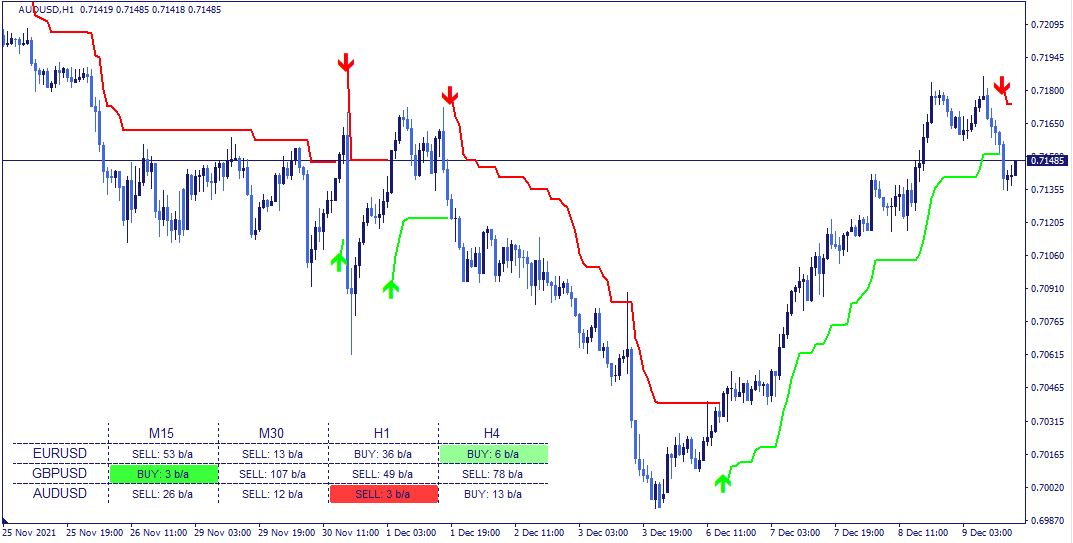
A bullish condition is registered when the SuperTrend line moves below price and is displayed in green — confirmed by a green directional marker. The bullish condition is deregistered when the line crosses above price and changes to red.
A bearish condition is registered when the line moves above price and is displayed in red — confirmed by a red directional marker. The bearish condition remains active until the line crosses back below price and changes to green.
The SuperTrend indicator reflects ATR-based calculations applied to historical price data. It does not predict future price movement. Registered conditions depend on the configured period and multiplier settings and should be evaluated within a broader analytical framework.
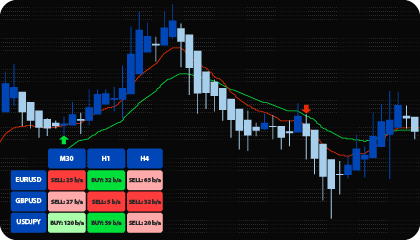
The dashboard displays the current detection status across all monitored instruments and timeframes.

The cell of the asset / timeframe contains information about the detected directional condition (bullish or bearish) and the number of bars back at which the condition was last registered.
The color of the cell indicates the directional context (bullish – green, bearish – red) and color saturation decreases as the number of bars since the last registered condition increases.
Clicking on any cell updates the chart to the corresponding instrument and timeframe.
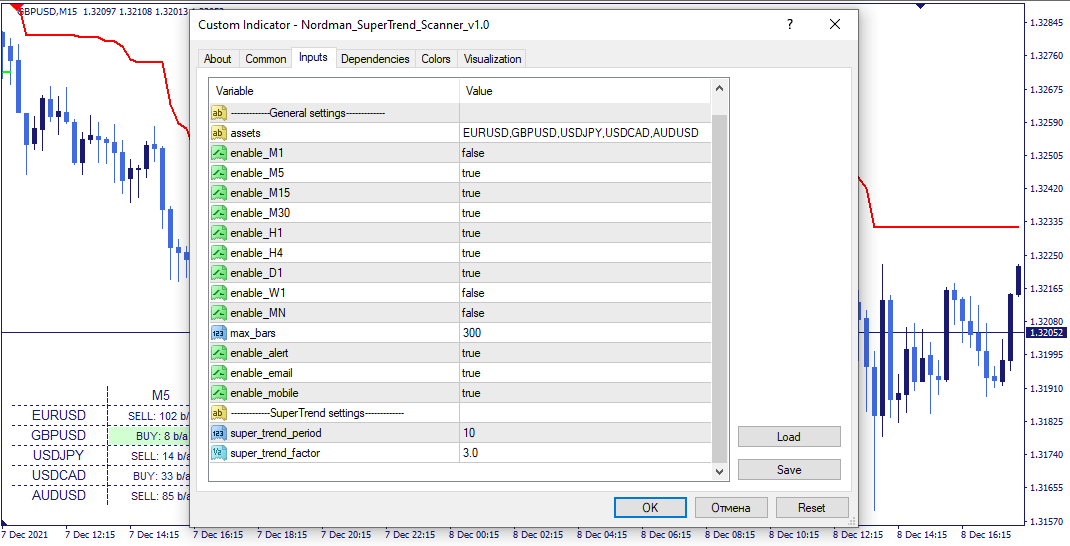
The indicator has the following parameters:
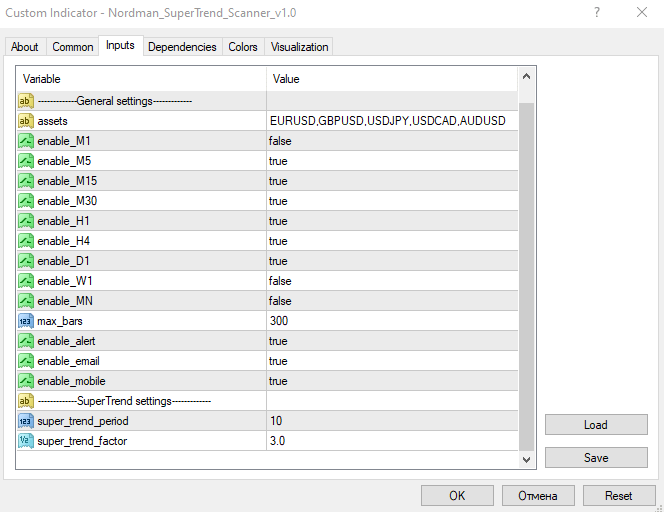
assets – selection of assets to monitor.
enable_M1 – enable_MN – include or exclude timeframes from the scanner scope.
max_bars – the maximum number of bars within which the scanner evaluates conditions. The parameter limits the number of calculations to speed up the indicator.
enable_alert – the option enables / disables alerts.
enable_email – allows you to send email alerts.
enable_mobile – allows you to send alerts to your mobile device.
SuperTrend settings – changing the key parameters of the indicator (period and multiplier).
We can customize this indicator to your requirements by adding new features, modifying calculation logic, or combining multiple tools into a unified solution.
We also develop automated trading strategies (Expert Advisors) based on custom logic. The system can include configurable management modules such as dynamic risk parameters, multi-stage trailing stops, additional confirmation filters, and other custom functionality based on your specifications.
The final solution is delivered with full source code and post-delivery support. Contact us for a free consultation to discuss the scope and timeline of your project.
We are committed to the ongoing development and refinement of our indicators. If you’ve spotted a bug, feel that something essential is missing, or have ideas that could make the indicator even better, just send us a message. Your feedback helps us improve and deliver tools that truly meet traders’ needs.
Nordman Algorithms is a trade name of Nordman Algorithms OÜ (Reg. No. 14435535), registered in Tallinn, Estonia.
Software Nature & User Responsibility — Nordman Algorithms provides algorithmic software tools for technical analysis. Nordman Algorithms is not a financial advisor and is not liable for any losses. All trades conducted based on the software’s output are executed at the user’s sole discretion and risk.
Visual Markers & Signal Disclosure — This software may display visual markers (such as arrows, dots, or alerts) when predefined mathematical conditions are met. These markers are provided for educational and analytical purposes only, must not be interpreted as financial guidance, and do not constitute a recommendation to buy, sell, or hold any financial instrument. Users must independently validate all visual cues within their own trading methodology.
No Financial Advice — Nordman Algorithms does not provide discretionary trading signals, investment advice, or managed signal services. Our software represents a mathematical visualization of historical and real-time data. The appearance of a visual marker does not guarantee a profitable trade or predict future market behavior.
Trading Risk Warning — Futures, Forex, and options trading involve significant risk. Risk capital is money that can be lost without jeopardizing financial security. Only risk capital should be used for trading. Past performance is not indicative of future results. View Full Risk Disclosure: https://www.nordman-algorithms.com/risk-disclosure/
ESMA Risk Warning — Financial instruments, especially those involving leverage such as CFDs and Forex, are complex and carry a high risk of rapid financial loss. Our software provides analytical outputs and visual markers based on predefined mathematical conditions and does not mitigate or reduce inherent market risks. You should carefully consider whether you understand how leveraged financial instruments work and whether you can afford the high risk of losing your capital.
CFTC Rule 4.41 — Hypothetical or simulated performance results have inherent limitations. Unlike actual performance records, simulated results do not represent real trading. Because trades have not actually been executed, these results may under- or over-compensate for the impact of market factors such as liquidity. No representation is being made that any account will achieve profits or losses similar to those shown.