A Scalping EA is an automated trading system designed for short-term position management on small timeframes — typically M1 to M15. It executes entries and exits according to predefined conditions derived from technical indicators, price patterns, or volatility thresholds, removing the need for continuous manual monitoring during active trading sessions.
Scalping strategies operate on compressed timeframes where the window between a condition being met and the moment of execution is measured in seconds. Manual execution introduces latency, inconsistency, and psychological pressure that accumulate across dozens of positions per session. An EA eliminates these variables by executing according to its defined logic at the speed of the platform’s order processing infrastructure — independent of the operator’s reaction time or attentional state.
The volume of computational work involved also exceeds what manual monitoring can sustain. A scalping EA can simultaneously track multiple instruments, apply multi-indicator filtering logic, and manage open positions across different timeframes — a workload that would require continuous screen time and carry a high probability of execution errors if done manually.
Most scalping EAs are built around two to three technical indicators that serve distinct analytical functions — typically one indicator for trend direction, one for momentum or volatility context, and one for entry timing. The combination reduces the probability of acting on low-quality conditions by requiring multiple analytical layers to align before a position is opened.
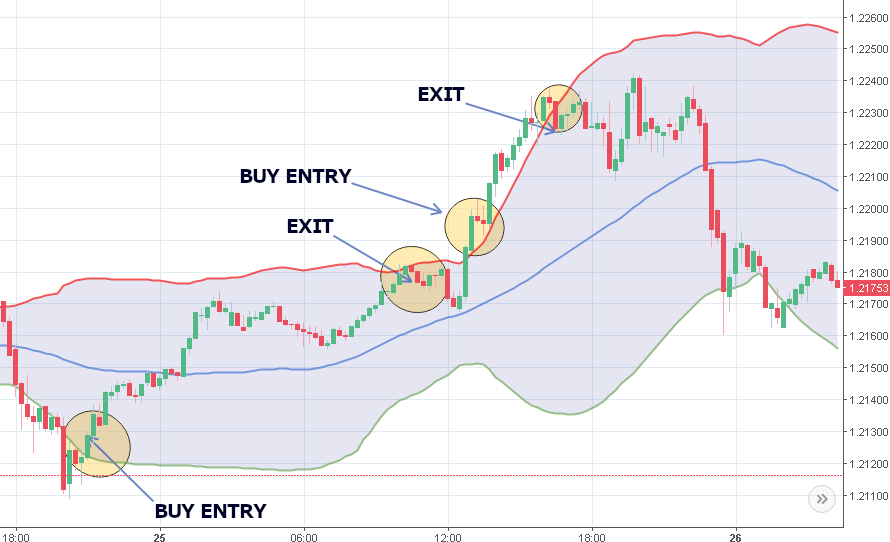
To illustrate the mechanics, consider a simplified example using the Bollinger Bands indicator. Bollinger Bands combine three moving averages to reflect trend direction, volatility range, and price position within that range simultaneously.
The EA monitors for specific price interactions with the band structure:
An upward condition is registered when price breaks above the lower band and closes inside it — reflecting a potential retracement within an established range. A secondary upward condition may be registered when price breaks through the central moving average and closes above it.
A downward condition is registered when price breaks below the upper band and closes within the band, or when price crosses the central moving average downward with a close below it.
Close conditions are defined symmetrically — an upward position may be closed when price reaches the central or upper moving average, depending on the configured target. A downward position may be closed near the central or lower moving average.
Scalping EAs operate under a specific set of structural requirements that distinguish them from medium- or long-term systems:
Timeframe range is typically M1 to M15, where price movements are small and execution speed is a primary operational variable. Stop distance is narrow — usually 1 to 10 points — which means spread and execution quality directly affect whether the strategy operates within its designed parameters. Position frequency is high, with some configurations generating dozens of position open/close cycles per session.
The internal logic can incorporate tick volume analysis, multi-indicator filtering, pattern recognition, or combinations of these approaches. The specific design depends on the underlying strategy.
The effectiveness of a scalping EA depends on several external factors that are independent of the EA’s logic itself. Asset liquidity affects execution speed — thin markets introduce slippage that can erode the margin on small-target positions. Spread level is a structural cost that must remain below the average position target for the strategy to operate as designed. Broker execution quality — including requote frequency and server latency — directly affects whether the EA’s order requests are filled at the expected price. A VPS is often used to ensure uninterrupted connectivity and consistent execution latency.
Scalping EAs execute according to their defined parameters and do not adapt to conditions outside their design envelope. Sudden volatility expansions, gap events, or sharp directional moves that exceed the EA’s configured range can produce sequences of positions that accumulate drawdown faster than the close logic can offset. The EA does not distinguish between a normal retracement and an event-driven price move. Monitoring and periodic reconfiguration based on current market conditions remain the responsibility of the user.
A scalping EA built to a specific strategy performs differently from a generic off-the-shelf system because the logic, parameters, and filtering conditions are defined by the strategy itself rather than by a general template. The entry conditions, close logic, position sizing rules, time filters, and instrument selection are all specified during development and implemented exactly as defined.
Our team develops scalping EAs of any complexity — from single-indicator systems to multi-instrument configurations with layered filtering logic. The development process begins with a detailed review of the strategy: entry and exit conditions, position management rules, timeframe scope, and any instrument-specific requirements. The EA is then built, verified against the specification, and tested on historical data before delivery.
The delivered EA includes full source code. Any issues identified after delivery are resolved at no additional cost.
To discuss your project, contact us through the form on our website. We will review your requirements and provide a detailed consultation and project estimate at no cost.